 努力小農
本文尚無譯文。
A warning from India: when consultation becomes a formality, smallholders bear the greatest risk
Carbon Farming Digest No. 5 · End of Heat|Seasonal feature
Behind a buying spree
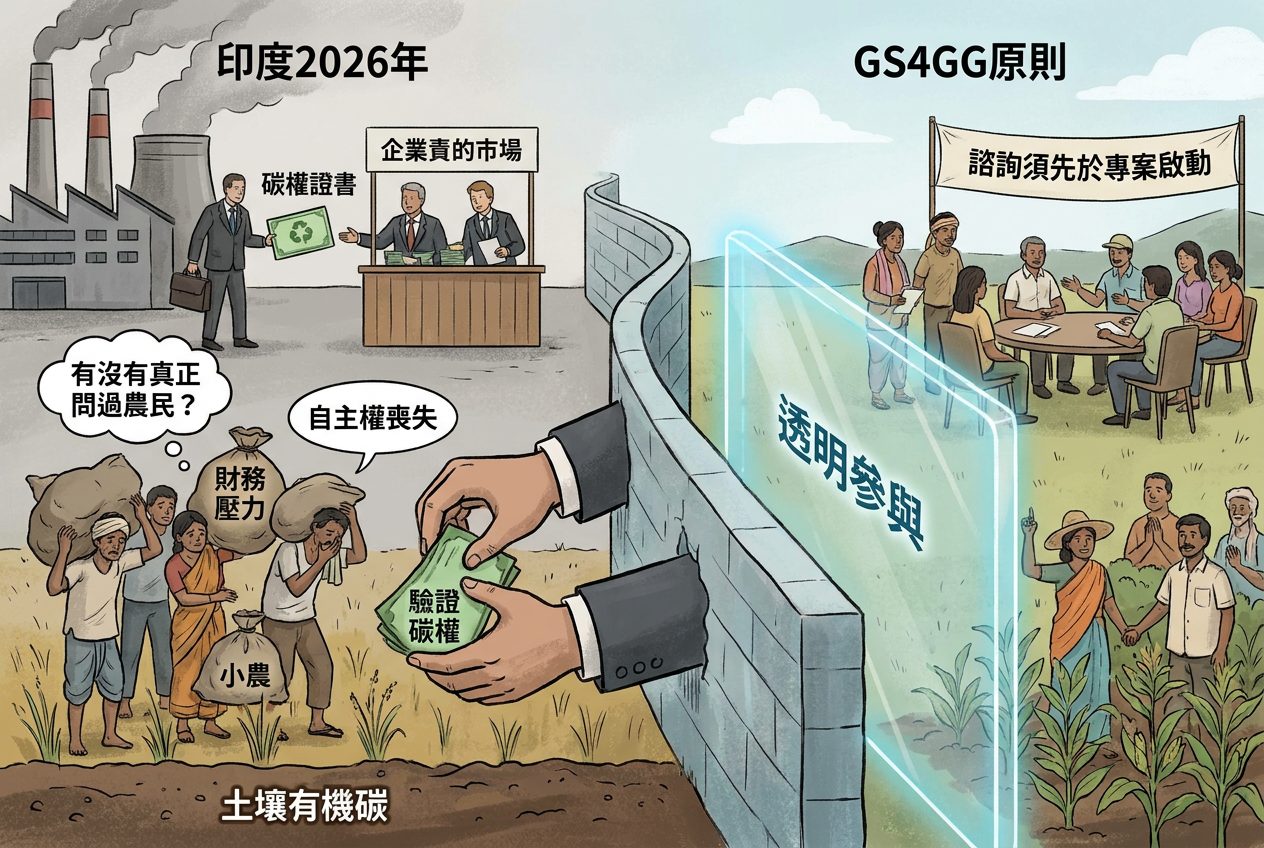
In 2026 India's new carbon trading scheme officially took effect. Under the compliance timetable, nearly 490 heavy-industry companies must meet their emission-offset obligations by the deadline, sparking a domestic rush to buy carbon credits — and soil organic carbon, relatively plentiful and affordable, has become their top target.
At first glance this is an encouraging market signal: companies are finally willing to pay real money for agricultural carbon sinks, and farmers should benefit. But several reports have poured cold water on that picture. Companies take the verified credits to offset their industrial emissions and achieve compliance on paper, while India's smallholders — on the front line of the land, actually changing how they farm and bearing the climate and harvest risks — are left alone to shoulder the financial pressure of long-term contracts, and have even lost the autonomy they once had over their own fields.
The rush has spawned an entire chain of “agtech aggregators” that recruit smallholders, build up carbon credit inventories and resell them to heavy-industry buyers anxious to comply — in effect quietly shifting industry's decarbonisation responsibility onto rural land. Reports call this structural risk the “Green Lock”: once farmers sign long-term contracts, land-management decisions are locked into a rigid framework, leaving almost no room to adjust even if the weather turns abnormal or markets change. More notably, this value chain rewards “those who collect the data” rather than “those who look after the land”. Satellite image analysis, soil sampling and compliance reviews — at every step, aggregators and MRV (monitoring, reporting and verification) bodies take substantial fees, and by the time the money actually reaches farmers, often only a meagre residue is left. Tech companies make steady, high profits, while smallholders alone carry long-term responsibility for the land and contractual risk.
A typical scenario illustrates how the mechanism works: an Indian smallholder growing groundnuts or cotton might first be attracted by small incentives from an aggregator, such as free soil testing or a small cultivation subsidy, and then sign a contract of ten years or more written in English or legal jargon. Once signed, the land must be farmed as the contract dictates for the next decade — even switching crops in a drought, or changing production methods as markets shift, requires the aggregator's consent first. (Note: this is an illustrative scenario of the structural risk described in reports, not a reference to any specific disclosed real case. Source: Why Soil Carbon Markets May Not Work in Favor of Smallholder Farmers? — ESG News.earth (July 2026) https://www.esgnews.earth/latest-news/why-soil-carbon-markets-may-not-work-in-favor-of-smallholder-farmers/21041.html.)
The problem is not whether there are carbon credits, but whether anyone was asked
What Taiwanese readers should chew over carefully is that this is not a scandal about fake carbon credits, nor a dispute over false monitoring data — on the surface, most of these credits have passed verification. What went wrong is the step before any trade happened: were farmers fully told, before signing long-term contracts, how the contract would restrict their future farming decisions? Was there an independent, open consultation process in which farmers, community representatives and local NGOs could review the project's terms together and object or ask for changes before signing?
When this step is skipped or reduced to a formality, everything that follows — however compliant on paper and however rigorous the verification — rests on an unequal power relationship: companies hold the money and legal resources, while farmers often hold only a contract they can barely understand but have already signed.
That is exactly why the Gold Standard for the Global Goals (GS4GG) makes “consultation before project start” a hard requirement in its Stakeholder Consultation and Engagement Requirements. GS4GG clearly requires consultation to be completed before a project formally starts, so that stakeholders can “genuinely influence the design, planning and implementation of the project”. If for some reason consultation takes place after the project starts, the developer must also explain how farmers' and communities' views were incorporated and what corresponding changes were made to the project design. This is not an administrative formality but a firewall — preventing “act first, report later” carbon credit development from shutting farmers out of the decisions that truly affect their land and livelihoods.
Taiwan's choice
The Indian case is a mirror. It reminds us that the faster agricultural carbon sink markets expand, the more likely such risks are to recur elsewhere — including in Taiwan. That is why the Small Farmers' Carbon Farming Project in Taiwan (GS11818) and the Chishang Smallholder Carbon Farming Project (GS23490) chose to proactively reconvene stakeholder consultation meetings as the methodology and activity modules were revised, rather than waiting until certification was over and everything was settled, and only then going back to fill in the paperwork.
We know that holding an open, in-person consultation meeting that covers all relevant parties takes far more work than writing up a plan in the office and submitting it for certification: booking a venue, coordinating farmers' travel and time, preparing explanations farmers can understand, opening a written feedback period of at least a month, and setting up long-term grievance channels. But it is precisely these “troublesome” procedures that mark the crucial difference between a responsible carbon credit project and a carbon credit deal that only wants to cash in quickly.
On 3 September, at NGO House in Taipei, we invite everyone who cares about this to come — to watch over us and to question us. This is the lesson of the Indian case: transparency and participation are never optional decorations, but the most basic and most important line of defence protecting the most vulnerable party.Register for the meeting 》》https://forms.gle/C6RScNkjtJr4GKgH9


