 努力小農
本文尚無譯文。
Weeding Crusaders Across Time: Satoyama ESG Sustainability from Noto to Hualien–Taitung
Carbon Farming Digest No. 6 · White Dew|Solar-term feature
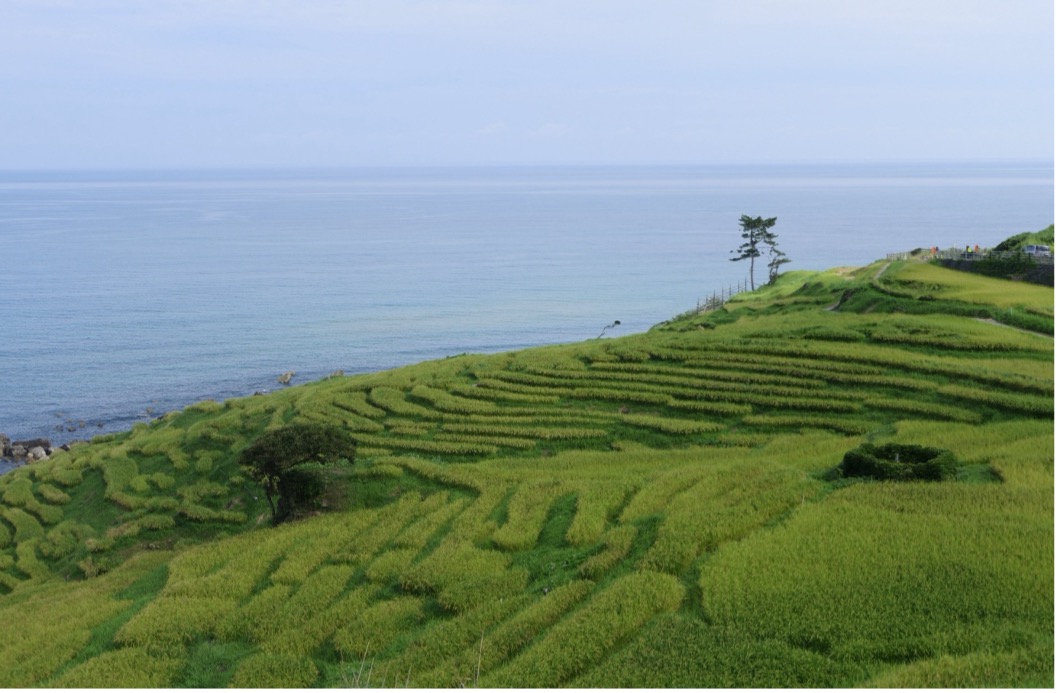
The Shiroyone Senmaida rice terraces in Wajima, Ishikawa Prefecture, Japan — one of the signature sites of the Globally Important Agricultural Heritage System "Noto's Satoyama and Satoumi".
Just after End of Heat, a silent soil revolution is under way at the Shiroyone Senmaida terraces in Wajima on Japan's Noto Peninsula. This world agricultural heritage site is a present-day echo of the spirit of the 1974 "Weeding Crusade" — when Toyama schoolteacher Kan Adachihara called on young people to weed newly planted forests by hand instead of with herbicides, a movement that ran for 43 years until it ended in 2016 as its members aged.
After the 2024 Noto earthquake, the Tzu Chi Foundation came to the area's aid and sponsored the Aikoukai association to rebuild homes under the Satoyama Initiative; Aikoukai then joined the Taiwan-led Noto Satoyama smallholder carbon farming project (Gold Standard GS23202). In 2025, Aikoukai decided to stop using herbicides altogether — so the terraces now need even more hand weeding. Companies and individuals fund weeding volunteers, and at the autumn harvest farmers repay their supporters with rice that carries carbon sink value.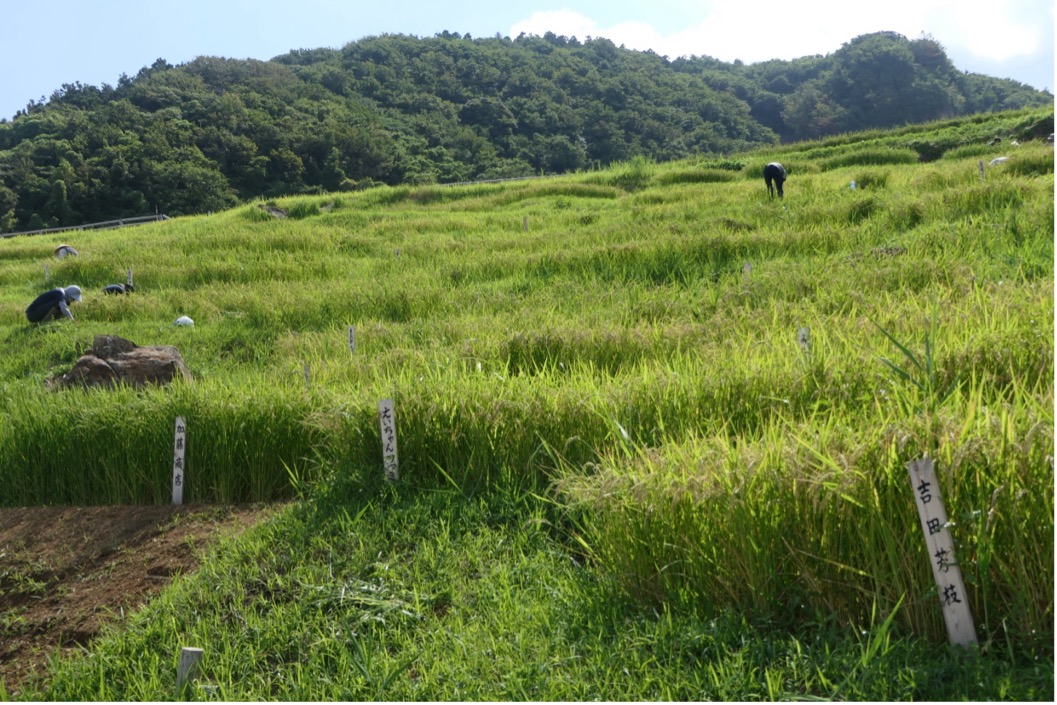
At the end of August, before the rice harvest, weeding volunteers from all over Japan come to help at Senmaida, and supporters' wooden name boards and corporate volunteer flags stand along the ridges between the paddies. Aikoukai hopes to recruit 1,004 "Weeding Crusaders" every year.
This spirit of "protecting the land with our own hands" finds a distant echo in Changliang Village, Yuli, Hualien — the birthplace of Taiwan's first internationally certified soil carbon sink project, which has brought together hundreds of local smallholders and generates about 1 tonne of carbon sink per hectare on average. From hand weeding in Toyama, to the wooden boards in Noto, to the waves of rice in Hualien and Taitung, across half a century and a sea, these hands that protect the land are now being passed to corporate chief sustainability officers and investors.
Lessons for Taiwanese companies: the five layers of impact of the ESG Green Shinkansen
The stories of Noto and Hualien–Taitung are moving, but for a chief sustainability officer, being moving is not enough to persuade a board to commit budget. The "ESG Green Shinkansen" translates this emotion into a concrete action map — a five-layer impact effect that starts from the core, "ESG smallholders", and spreads outwards to corporate procurement, internal engagement and employees' everyday consumption, finally linking the upstream and downstream supply chain. Every layer corresponds to Taiwan's current (2026) corporate ESG evaluation indicators, so that "supporting smallholder carbon farming" is no longer a one-off donation but an ongoing action that fills several of the UN's 17 SDGs at once.
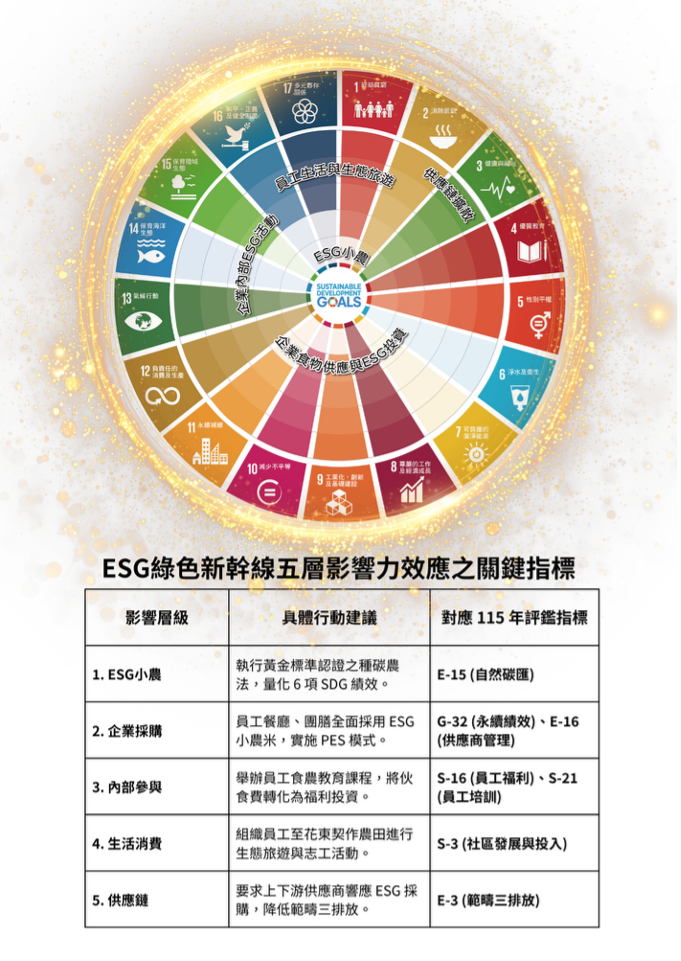
Key indicators of the ESG Green Shinkansen's five-layer impact effect.
Starting from the core, "ESG smallholders" (practising Gold Standard–certified carbon farming and quantifying six SDG outcomes, corresponding to 2026 evaluation indicator E-15 natural carbon sinks), companies can spread this impact outwards layer by layer: using ESG smallholder rice throughout staff restaurants and catering and adopting a payment for ecosystem services (PES) model (corporate procurement, corresponding to G-32 sustainability performance and E-16 supplier management); running food and farming education courses for employees, turning meal budgets into an investment in employee benefits (internal engagement, corresponding to S-16 employee benefits and S-21 employee training); organising employee eco-tours and volunteer activities on contract farms in Hualien and Taitung (everyday consumption, corresponding to S-3 community development and involvement); and finally asking upstream and downstream suppliers to adopt ESG procurement to reduce Scope 3 emissions (supply chain, corresponding to E-3 Scope 3 emissions). The five interlocking layers are what the ESG Green Shinkansen really looks like — not a one-off charitable donation, but a system that the finance, HR, procurement and PR departments can each use to report against their own internal KPIs.
A quiet soil revolution is unfolding on Noto Peninsula's terraced rice fields — a living echo of Japan's 1974 "Weeding Crusade." After the 2024 Noto earthquake, local farmers joined Taiwan's Gold Standard carbon-farming project, and in 2025 stopped using herbicides entirely, inviting corporate sponsors to fund volunteer weeders. The same spirit echoes in Hualien's Changliang Village, Taiwan's first internationally certified soil-carbon project. For Taiwanese enterprises, the "Green Shinkansen" Five-Layer Impact framework offers a concrete action map: starting from ESG smallholder farmers at the core, impact ripples outward through corporate procurement, internal employee engagement, employee lifestyle spending, and finally the supply chain — each layer mapped to Taiwan's current corporate ESG rating indicators. Supporting carbon farming becomes not a one-off donation, but a sustained system that finance, HR, procurement, and PR teams can each report against.


