 努力小農
While others cut budgets, we build assets
本文尚無譯文。
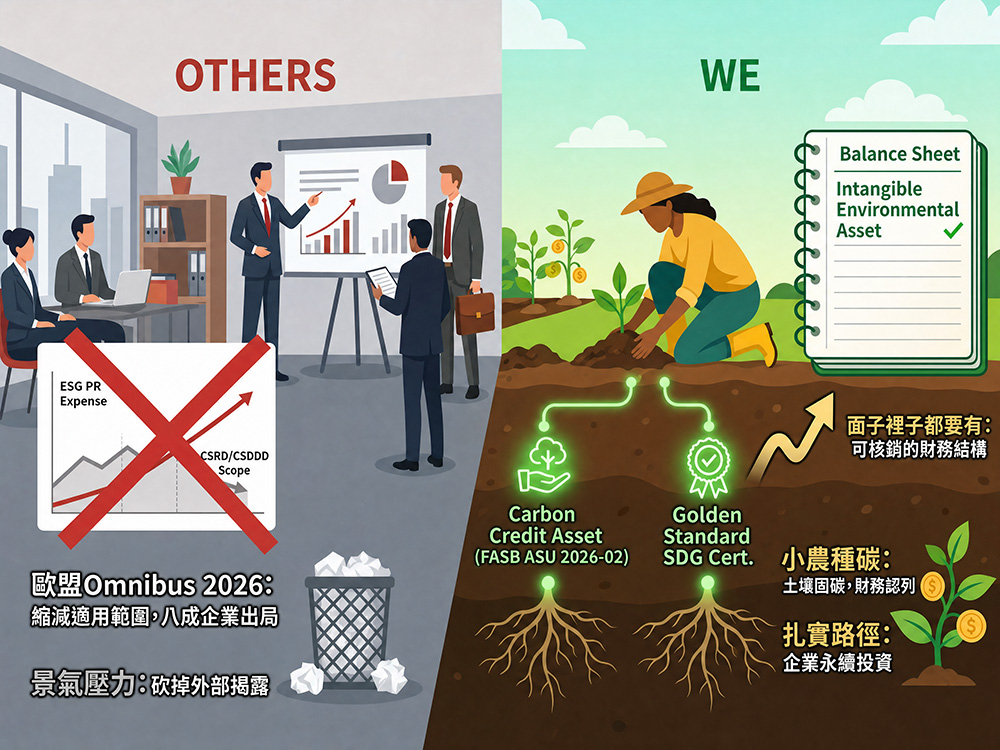
While others cut budgets, we build assets
When “doing ESG” becomes a PR expense companies can cut at any time, the carbon actually sequestered in soil can take a more solid path.
In February 2026 the EU published its Omnibus simplification package, sharply narrowing the scope of the CSRD (Corporate Sustainability Reporting Directive) and CSDDD (Corporate Sustainability Due Diligence Directive): the thresholds rose to more than 1,000 employees and more than €450 million in turnover, removing about 80% of previously covered companies outright. The EU itself estimates this saves €4.4 billion a year in reporting costs. Even the birthplace of double materiality and human-rights due diligence was first to cut “disclosure of impacts on the outside world” under economic pressure — which shows that relying on moral language alone to persuade companies to invest in sustainability for the long term is not realistic.
At the same time, however, another path is opening. In May 2026 the US Financial Accounting Standards Board (FASB) issued ASU 2026-02, the first-ever accounting standard on how “environmental credits” (including carbon credits) are recognised on the balance sheet. It requires carbon credit assets to be presented gross, not netted against obligations. This means that, for the first time, the carbon credits a company holds can be more than a touching story in a CSR report — they can go into the financial statements as assets that can be seen and measured.
This is exactly the direction Smallholder Carbon Farming and Gold Standard SDG impact certification are taking: not packaging soil carbon sequestration as a charity activity, but making it a genuine intangible asset for companies —
the outward image (ESG reputation) and the substance (a financial structure that can be written off) together. That is the kind of sustainable investment Taiwanese companies really need — and the kind that lasts.
The ESG Green Shinkansen: how materiality spreads from the food chain to the sustainability value chain
Materiality is not a point but a path. Just as a Shinkansen runs station to station without detours, the materiality of agricultural carbon sinks starts from the most basic level, the food chain, spreads along the supply chain and finally reaches the company's sustainability value chain. That is where the name “ESG Green Shinkansen” comes from. If a company's sustainability investment stops at a single station — say, buying carbon credits without linking them to supply-chain accounting and value-chain disclosure — materiality gets stuck halfway and never really reaches the board and investors.
| Station | Where materiality arises | In concrete terms |
|---|---|---|
| Station 1 Food chain | Carbon in the soil and harvests on the farm — the original starting point of materiality, closest to the land yet most easily overlooked. | Higher soil organic carbon, food security, farmers' incomes and health (SDG 2, SDG 3, SDG 8). |
| Station 2 Supply chain | Companies formally write carbon credits and SDG impacts into purchasing contracts, raw-material sourcing inventories and Scope 3 emissions calculations; materiality begins to spread into day-to-day operations. | Agricultural carbon credits become items on the balance sheet that can be written off (FASB ASU 2026-02); ESG purchasing and supplier due-diligence records. |
| Station 3 Sustainability value chain | Data are integrated into ESG reports, dual disclosure under IFRS S1/S2 and ESRS, and investor communications; materiality completes the last stretch. | From “what happened on a plot of farmland” to “can this company's long-term value withstand the test of climate risk?” |
In other words, if ESG funds invested in smallholder carbon farming stop at the station of “how many carbon credits were bought”, their value stays at the food-chain level. Only when a company is willing to extend the investment into purchasing and supply-chain accounting, and further integrate it into sustainability reports under IFRS S1/S2 and ESRS, does materiality truly complete the journey — turning a handful of soil from the farm into long-term value that investors are willing to pay for.


