 努力小農
本文尚無譯文。
With the Carbon Fee Here, Who Can Really Get the Money to Farmers?
Carbon Farming Digest No. 6 · White Dew|Solar-term feature
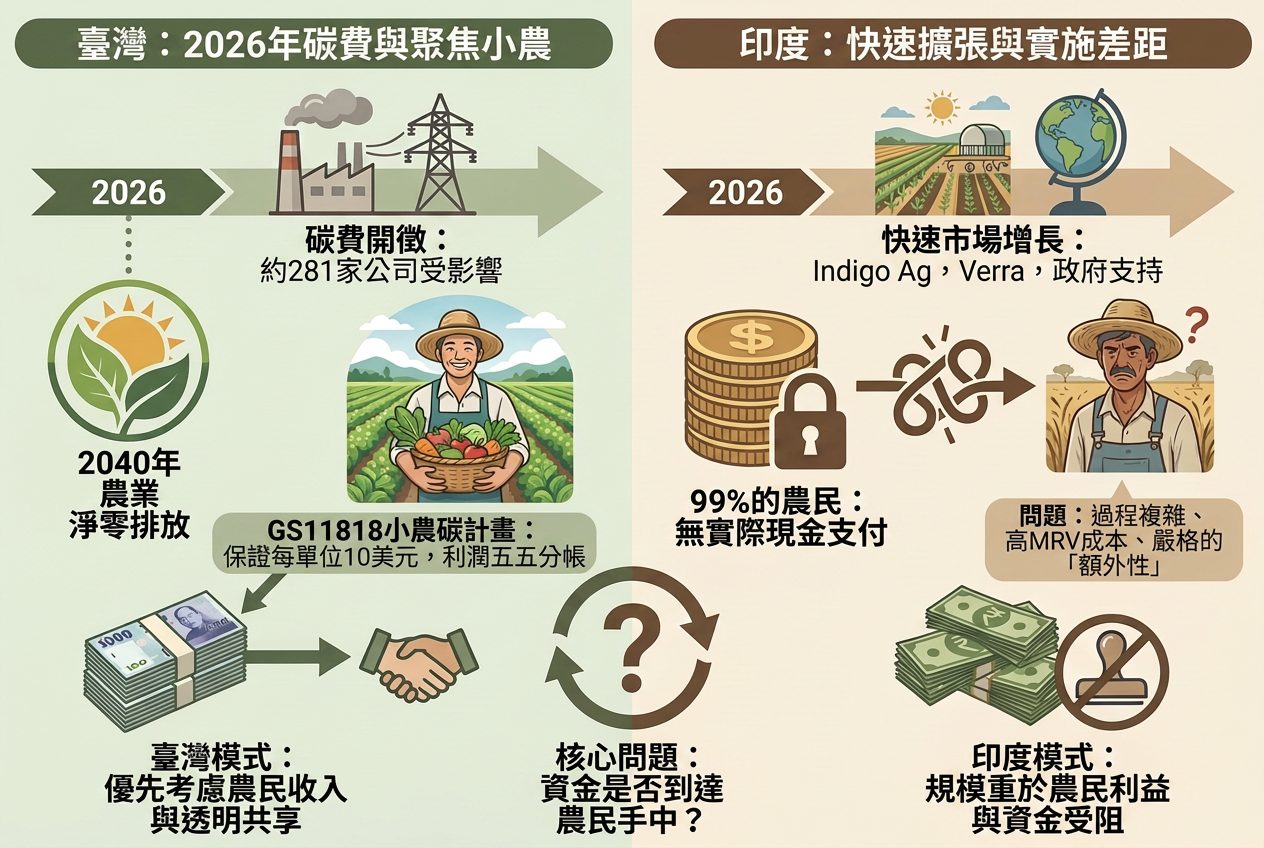
2026 is the first year Taiwan's carbon fee really takes effect: power and manufacturing companies emitting 25,000 tonnes or more a year must pay a carbon fee based on their actual 2025 emissions, and the Ministry of Environment estimates about 500 emission sources at 281 companies are affected. Meanwhile, the Ministry of Agriculture continues to push "net-zero agriculture by 2040"; last year, soil and water conservation and rural regeneration works achieved an emission reduction rate of 16.55%, beating the 15% target. Government governance evaluations are also discussing whether to count smallholder carbon farming as a bonus item in corporate ESG ratings to encourage companies to invest.
The case of India: scale grew fast, but the money got stuck halfway
Internationally, India has been the fastest-growing agricultural carbon credit market of the past two years, but it is also the case with the biggest gap between "scale" and "money actually reaching farmers".
In January 2026, the Aadi project of Grow Indigo — a joint venture between US company Indigo Ag and an Indian partner — was approved by Verra. Its first issuance covered about 30,000 acres of farmland in Punjab and Haryana and produced more than 50,000 tonnes of carbon credits, making it India's first soil carbon credit case to meet the "high-integrity" threshold. In the same year, India's central government budget for 2026–27 for the first time set up a ₹20,000 crore support scheme for carbon capture, utilisation and storage (CCUS), formally bringing farmers into the national carbon trading system, to be folded into the upcoming Carbon Credit Trading Scheme (CCTS). In 2026, soil carbon credit prices in India's voluntary market were roughly ₹500–2,500 per tonne.
But as scale expanded, gaps in implementation were also exposed. A 2025 Indian case study found that about 99% of farmers taking part in carbon sink projects had never actually received any cash payment; another independent survey covering 841 farmers likewise showed that 99% of respondents had no real access to carbon market revenue. Researchers point to complex procedures, a lack of local intermediary aggregation, and the high cost of MRV (monitoring, reporting and verification). The internationally used "additionality" threshold — which only recognises carbon storage that "would not have happened without carbon finance" — also leaves many farmers who had already adopted eco-friendly farming unable to get their assets recognised, weakening the incentive for large-scale participation.
By contrast, the GS11818 smallholder carbon farming programme sets a guaranteed purchase price of US$10 per unit and a 50/50 revenue split with farmers after necessary costs, and Eco-affinity Inc. charges farmers nothing extra for due diligence. This is the key difference between the Taiwanese model and India's large-intermediary model: India's path shows that "scaling up fast" and "farmers getting paid" are two different things, and Taiwan has chosen to put the latter first.
The start of the carbon fee, bonus points in ESG ratings and the lessons of the Indian market all point to the same question: now that companies are finally willing to pay for agricultural carbon sinks, does the money actually reach farmers? This is an indicator every future issue of the digest will keep tracking.
2026 marks the first year Taiwan's carbon fee is actually enforced, with roughly 281 companies and 500 emission sources affected. Internationally, India has seen the fastest scale-up in agricultural carbon markets — but also the widest gap between scale and farmer payouts. In January 2026, Grow Indigo's Aadi project became India's first Verra-approved, high-integrity soil carbon project, covering 30,000 acres and generating over 50,000 credits; India's 2026–27 budget also created a ₹20,000 crore carbon capture support scheme formally bringing farmers into the national carbon trading system. Yet separate research found that nearly 99% of Indian farmers enrolled in carbon projects have never actually received a cash payout, due to complex processes, high MRV costs, and additionality requirements that exclude many farmers from asset recognition. By contrast, Taiwan's GS11818 project guarantees a fixed purchase price of US$10 per unit and a 50/50 profit split with farmers, with no additional fees charged to them. As carbon fees, ESG ratings, and India's lessons converge, the real question is simple: when companies finally pay for agricultural carbon, does the money actually reach the farmers?
Sources
Grow Indigo's first high-integrity soil carbon credits reach issuance: https://www.indigoag.com/pages/news/indian-farmers-unlock-a-new-harvest-as-grow-indigos-first-high-integrity-soil-carbon-credits-reach-issuance
India's 2026 budget: ₹20,000 crore carbon credit scheme (The Better India): https://thebetterindia.com/farming/union-budget-2026-carbon-credit-scheme-for-farmers-how-to-earn-more-from-land-expert-tips-11067208
Budget 2026 and unlocking India's agricultural carbon credits (The Federal): https://thefederal.com/category/farm-matters/india-soil-carbon-credits-grow-indigo-adi-227175
Study on Indian smallholders' carbon farming income: 99% of farmers received no cash payment (ESG News.earth): https://www.esgnews.earth/latest-news/why-soil-carbon-markets-may-not-work-in-favor-of-smallholder-farmers/21041.html
Research on additionality thresholds and barriers to smallholder participation (Taylor & Francis): https://www.tandfonline.com/doi/full/10.1080/14693062.2024.2416497
Agricultural carbon credit methodologies and regenerative agriculture market trends (Senken): https://www.senken.io/academy/carbon-methodologies/regenerative-agriculture
Taiwan's carbon fee collection and progress towards net-zero agriculture (Newtalk): https://newtalk.tw/news/view/2026-08-10/1052332
Linking smallholder carbon farming to corporate ESG ratings (CSRone): https://csrone.com/news/9884


