 努力小農
The beauty and sorrow of today's carbon credit market: two extremes of international carbon farming stories
本文尚無譯文。
Carbon credit markets / International cases
The beauty and sorrow of today's carbon credit market
Two extremes of international carbon farming stories
Carbon farming and carbon credit markets are not only happening in Taiwan; many similar stories are unfolding internationally — some inspiring, some alarming.
The inspiring: keeping the returns with those who farm
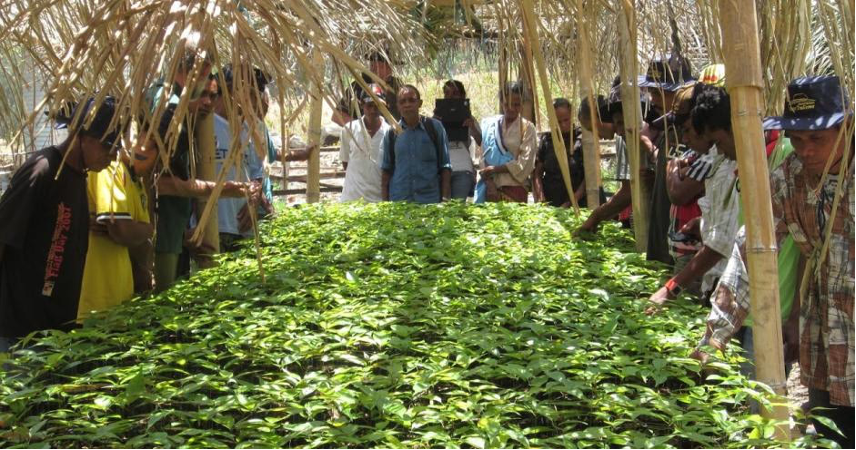
First, the inspiring. In Timor-Leste, off the coast of Indonesia, a community reforestation project called WithOneSeed (Gold Standard ID GS 4210) in the Baguia area pays local smallholders directly per surviving tree. This model has let more than 1,000 farming households earn steady carbon credit income by planting native trees back on degraded farmland, while gradually restoring soil fertility — almost exactly the same logic as what we do in Chishang and Yuli: keeping both the responsibility for caring for the land and its returns in the hands of the people who actually farm it.
farming households earning carbon credit income
In south-western Ethiopia, the Humbo Assisted Natural Regeneration project (Gold Standard ID GS 1922) uses another, cheaper approach: letting tree roots sprout naturally and regrow into forest, rather than replanting tree by tree. The project has not only restored 2,724 hectares of degraded land and removes nearly 30,000 tonnes of carbon dioxide a year; more importantly, it formally returned legal ownership of the land to seven community cooperatives — the carbon credit project became an opportunity for smallholders to regain control of their land.
degraded land restored
regaining land ownership
The alarming: trust abused
But the carbon credit market also has an alarming side. This year the US Department of Justice brought criminal charges against CQC Impact Investors, one of the world's largest carbon credit developers, alleging that its CEO and head of carbon assets spent years tampering with monitoring data for clean cookstove projects, exaggerating the stoves' actual emission reductions to fraudulently obtain carbon credits worth millions of dollars — the CEO himself could face up to 80 years in prison. A team of German journalists also investigated a carbon credit developer in Xinjiang, China, “Beijing Karbon”, finding that buildings at some declared project sites had been built before the projects were approved — in other words, the whole emission reduction may have been made up, in deals estimated to be worth hundreds of millions of euros.
charged by the US DOJ; not yet adjudicated
media investigation; not yet confirmed
Two extremes, one conclusion
Seen side by side, the two extremes point to the same conclusion: the value of a carbon credit never lies in the certificate itself, but in whether behind it there is land that has truly been well treated, data that have been honestly recorded, and returns that have been fairly shared. That is why we have always insisted on following the Gold Standard methodology, testing every soil sample in an ISO 17025–accredited laboratory and estimating carbon credits conservatively — because we know that once trust is abused, those hurt most are always smallholders like Lin Shih-feng and Chan Ming-jung who really put in the work in the fields.
Once trust is abused, those hurt most are always smallholders like Lin Shih-feng and Chan Ming-jung who really put in the work in the fields.
Sources for the international stories (for checking / attribution)
Good cases
- WithOneSeed Timor-Leste Community Forestry Program(Gold Standard GS 4210)— regreener.earth, "The 5 Best Gold Standard Carbon Credit Projects of 2026"
- Humbo Ethiopia Assisted Natural Regeneration (Gold Standard GS 1922) — as above
Bad cases
- CQC Impact Investors clean cookstove fraud case (US Department of Justice indictment) — crbn.credit, "Carbon Credit Fraud 2026: Real Cases, Red Flags & Verification Checklist"
- Beijing Karbon Xinjiang carbon credit project investigation — Deutsche Welle and ZDF investigative reporting, cited in the crbn.credit article above
Further background (systemic problems with REDD+ forest carbon credits; details not cited in this article, for further reading)
- Research by Dr. Thales A. P. West et al. in Global Change Biology, cited in The Canary, "Carbon credits exposed: the billion-dollar scam built on 'hope, not proof'" (24 October 2025)


