 努力小農
Give carbon back to the soil, leave resilience in the fields
本文尚無譯文。
Regenerative agriculture / Climate resilience
Give carbon back to the soil, leave resilience in the fields
At the World Agri-Food Innovation Conference in Beijing, the keyword mentioned again and again was “soil organic carbon”.
In September 2026 the 2026 World Agri-Food Innovation Conference (WAFI) closed in Pinggu, Beijing. One of the six consensus points it reached was “green, sustainable and climate-resilient development of agriculture and food”, explicitly calling for more efficient use of land, water, fertiliser, pesticides and energy, and stronger farmland protection and soil health. And in all the discussions, the keyword mentioned again and again was “soil organic carbon”.
Soil health has long been underestimated
At the conference's first-ever forum on regenerative agriculture, participants agreed that the role of soil health in responding to climate change has long been “largely underestimated”. There is solid science behind this: the soil organic carbon pool is the largest ecosystem carbon pool on the Earth's surface, but long-term extensive farming has caused large losses of carbon. Healthy soil can “lock” more carbon underground and make farmland more resistant to drought, waterlogging, pests and diseases; conversely, degraded soil releases carbon and amplifies the systemic risks of farm production.
A miniature reservoir, and a miniature drainage system
Research shows that soil organic carbon can improve farmland's ability to withstand both drought and waterlogging because it promotes the formation of soil aggregates, markedly increasing porosity and water-holding capacity. Soil rich in organic carbon acts like a sponge in the dry season, holding more water for crop roots; when torrential rain comes, good aggregate structure lets water infiltrate quickly, reducing surface runoff and the time fields stay waterlogged.
In the dry season, like a sponge
Aggregate structure holds more water for crop roots.
When torrential rain comes, fast infiltration
Good aggregate structure lets water drain down, reducing surface runoff and waterlogging.
Long-term conservation tillage trials confirm this: reduced tillage, returning straw as mulch, rotation and cover crops all effectively raise soil organic carbon, increase soil moisture and reduce crop water use, in turn improving yields and water-use efficiency. In other words, every inch of soil rich in organic carbon is a miniature reservoir, and a miniature drainage system.
Every inch of soil rich in organic carbon is a miniature reservoir, and a miniature drainage system.
The difficulty of regenerative agriculture: the benefits take time, the costs don't wait
This path points to a farming model that has grown rapidly worldwide in recent years — regenerative agriculture: through systemic practices such as minimising soil disturbance, returning straw as mulch, rotation and intercropping, cover crops and keeping living roots in the soil, it rebuilds the soil's ecological functions and accumulates carbon in farmland while maintaining productivity.
Minimal soil disturbance / Straw returned as mulch / Rotation and intercropping / Cover crops / Living roots
But moving from idea to large-scale practice is no small challenge: differing understandings, technical bottlenecks, and a disconnect between resources and markets all weaken farmers' motivation to transition. The core difficulty is that the benefits of regenerative agriculture — higher organic carbon, better water retention, stable yields — often take years to appear, while the costs and yield fluctuations early in the transition are immediate.
Representatives of financial and research institutions at the conference argued that without risk-sharing mechanisms and financial instruments, technology promotion alone will struggle to take root.
The policy figures
On the policy side, China's official 2026 Report on Low-Carbon Development of Agriculture and Rural Areas shows that total agricultural carbon emissions have levelled off and emission intensity continues to fall; between 2005 and 2021, carbon sinks in China's farmland and grassland held steady at 170–187 million tonnes of CO₂ equivalent, and the share of emissions neutralised by these sinks rose from 10.36% to 18.28%.
2005–2021
up from 10.36%
In major producing areas such as the Huang-Huai-Hai plain, a five-part integrated technical system — “precise early warning, resilient varieties, resilient farmland, prevention and loss reduction, rapid reconstruction” — is also being demonstrated.
- Precise early warning
- Resilient varieties
- Resilient farmland
- Prevention and loss reduction
- Rapid reconstruction
From “fighting the climate” to “managing the soil”
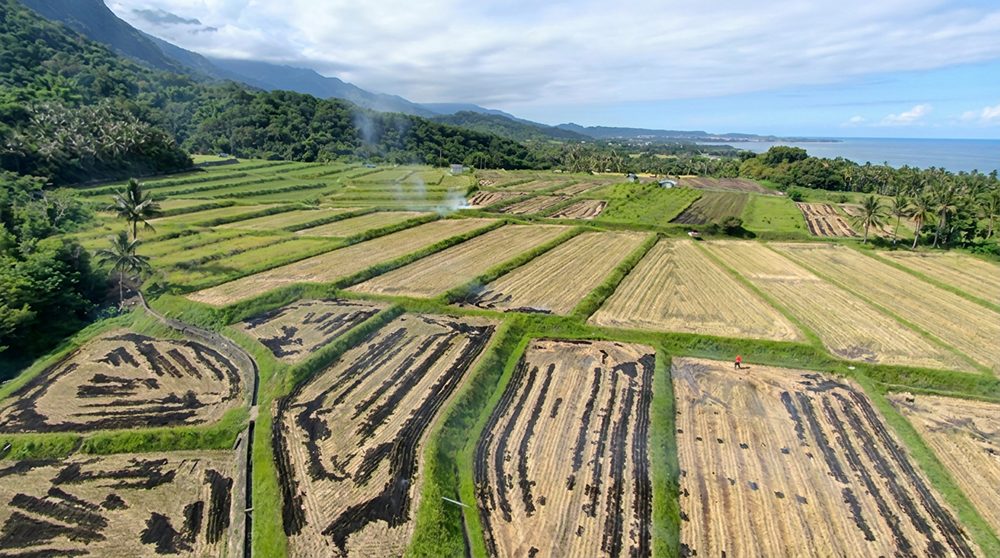
Although this report is about China's policies and a large forum, its core logic is almost exactly the same as what we do in Chishang, Yuli and Madou: the essence of climate-resilient agriculture is shifting from “fighting the climate” to “managing the soil” — raising soil organic carbon so the land “grows” its own resistance, making it the first line of defence against extreme weather. Taiwan's smallholders have been on this path for four years; this conference in Beijing reminds us that it is not just a small thing we are doing, but a shared challenge the whole world is taking seriously.
Raising soil organic carbon so the land “grows” its own resistance, making it the first line of defence against extreme weather.
Source:
Beijing Nonglian, “Give carbon back to the soil, leave resilience in the fields”, 14 October 2026.


