 努力小農
Stop misusing “pancha”: one word muddling seven international concepts
本文尚無譯文。
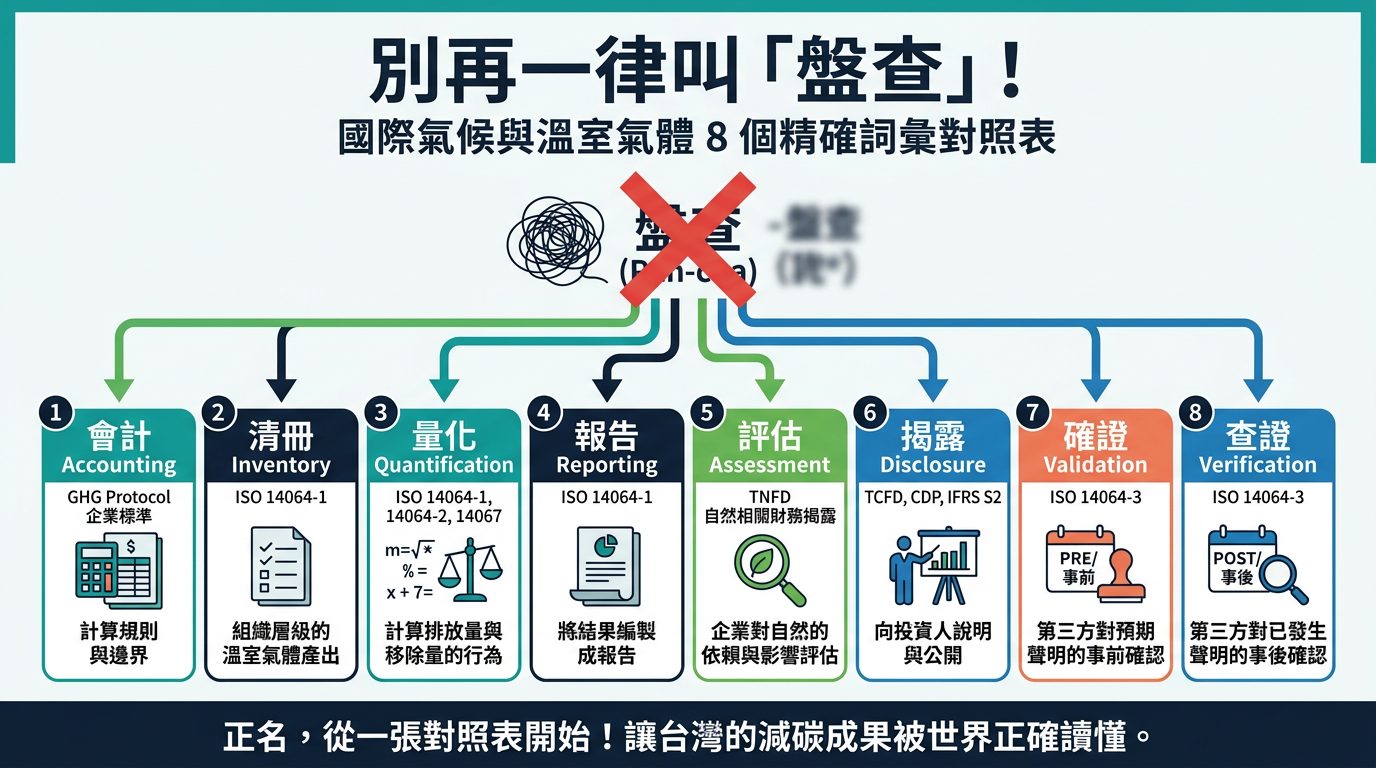
Getting the terms right / Greenhouse gases
Stop misusing “pancha”
One word muddling seven international concepts
New rice for the Start of Winter is in the shops. Walk into a rice store and the shelves hold Koshihikari, Taikeng No. 9 and Tainan No. 11, as well as brown rice, germ rice and white rice. If the shopkeeper labelled every bag simply “rice”, anyone who knows their food would probably turn round and walk out — variety, degree of milling and taste value decide whether it cooks up springy or loose, dry and hard.
Yet with greenhouse gases, that is exactly what Taiwan does: whatever the original international standard says, it is all labelled “pancha” (盤查, roughly “inventory check”).
In the originals, there are at least seven words
Open the original texts and you find they use different words with a clear division of labour and precise definitions — at least seven of them:
Accountingaccounting
The full English name of the Greenhouse Gas Protocol (GHG Protocol) Corporate Standard is the “Corporate Accounting and Reporting Standard”; it deals with the rules and boundaries for calculating emissions.
Inventoryinventory
ISO 14064-1 from the International Organization for Standardization (ISO) sets out the organisation-level greenhouse gas inventory — an output.
Quantificationquantification
The act of calculating emissions and removals, as in ISO 14064-1, ISO 14064-2 and the product carbon footprint standard ISO 14067.
Assessmentassessment
Used by the Taskforce on Nature-related Financial Disclosures (TNFD) to assess companies' dependencies and impacts on nature — not an emissions calculation.
Disclosuredisclosure
At the heart of the Task Force on Climate-related Financial Disclosures (TCFD), the Carbon Disclosure Project (CDP) and International Financial Reporting Standards S2 (IFRS S2): explaining to investors.
Verificationverification
ISO 14064-3 sets out independent third-party confirmation, after the fact, of statements about what has already happened.
Validationvalidation
Also from ISO 14064-3: third-party confirmation, in advance, of forward-looking statements (such as a project design).
In Taiwan, all of them are called “pancha”
In Taiwan, almost all of these are called “pancha”. Even the Ministry of Environment's Guidelines for Greenhouse Gas Emissions Pancha call the GHG Protocol the “Greenhouse Gas Pancha Protocol”, though the word appears nowhere in the original name; the Scope 3 standard plainly says “accounting” in English, yet the Taipei Exchange's outreach materials still call it “Scope 3 pancha”. One source of this is that the regulation's own name is the “Regulations for Greenhouse Gas Emissions Pancha, Registration and Inspection”, and over time the error became accepted as correct. Yet in that same name “pancha” and “inspection” stand side by side, showing that the two were never the same thing.
The strongest counter-evidence comes from the authorities themselves
The strongest counter-evidence comes from the authorities themselves. The Glossary of Climate Change Terms published in 2023 by the Environmental Protection Administration (now the Ministry of Environment) translates Greenhouse Gas Inventory as “溫室氣體清冊” (greenhouse gas inventory), National Inventory Report as “國家清冊報告”, and Measurement, Reporting and Verification (MRV) as “量測、報告與查證”. Leaf through the whole glossary and “pancha” appears only twice: once in the introduction's statement of scope, and once in the title of a reference; no entry is named after it, and no English equivalent can be found. In other words, the government's glossary has never defined “pancha”, yet the government's regulations and guidelines use it throughout; the glossary renders verification as “查證”, while the regulation's name uses “查驗” (inspection). The authorities' own documents don't match each other.
The government's glossary has never defined “pancha”, yet the government's regulations and guidelines use it throughout.
A word that has never been defined has been used as a technical term for years, spreading from regulations, guidelines, training courses and consultancy services all the way into companies' sustainability reports and board presentations. Everyone says “pancha”, yet no one can say clearly which English word it actually stands for. This is not one company's oversight, but an error the whole system has come to accept as right.
Mixing them up also flattens differences between standards
Mixing them up also flattens the differences between standards. For example, the GHG Protocol divides emissions into Scopes 1, 2 and 3, while ISO 14064-1:2018 divides them into six categories: direct emissions and removals; indirect emissions from imported energy; transportation; products used by the organisation; use of the organisation's products; and other sources. The two classifications can be mapped against each other, but not simply equated. If everything is just called “pancha”, readers of a report cannot tell which set of boundaries the figures were calculated under, and comparison loses its meaning.
GHG Protocol
- Scope 1
- Scope 2
- Scope 3
ISO 14064-1:2018
- Direct emissions and removals
- Indirect emissions from imported energy
- Transportation
- Products used by the organisation
- Use of the organisation's products
- Other sources
Why be so particular? A small slip, a big miss
Why be so particular? Because a hair's-breadth error can end a mile off. First, responsibility becomes blurred. When a company says “we've done pancha”, listeners can't tell whether it calculated the figures itself or had them verified by a third party; the former is a self-declaration, only the latter carries credibility. Second, timing gets misplaced. Validation happens before a project starts, verification after it is carried out; mix them up and you may go to the wrong body at the wrong time. Third, international communication goes astray — at higher cost. The Taiwan Stock Exchange's newly published 2027 ESG (Environmental, Social and Governance) evaluation indicators score English-language sustainability reports (indicator G-36), Chinese and English annual reports (G-4) and Chinese and English websites (G-28), with extra points available for English annual financial reports (G-23). If key words go wrong in translation from Chinese to English, which English word “pancha” should correspond to is left to the translator's guesswork, and international investors and rating agencies end up reading a report whose meaning is unclear; as misunderstandings grow, the damage falls on the company's reputation, and on the country's image too.
- Responsibility blurs: self-declaration, or third-party verification?
- Timing gets misplaced: validation before a project starts, verification after it is carried out
- International communication goes astray: with English reports and evaluation indicators, mistranslated key words cost more
Carbon farming projects care about this especially
Carbon farming projects care about this especially. In the Gold Standard soil organic carbon projects we run in Hualien and Chishang, every step has a clear name: the project design must be validated, each year's soil sampling and calculation is monitoring and quantification, and only after independent third-party verification are carbon credits issued. Use the wrong word at any stage and the documents may have to be corrected, and a whole year of farmers' work may be held up halfway.
- Validationproject design
- Monitoringannual soil sampling
- Quantificationcalculation
- Verificationindependent third party
- Carbon credits issued
Getting the terms right starts with a comparison table
Getting the terms right starts with a comparison table. We recommend that companies and the authorities follow the original international standards and use these Chinese translations consistently:
We also call on the authorities to build on the translations already in the Glossary of Climate Change Terms and gradually correct the wording in regulation names, guidelines and evaluation documents, so that domestic rules and international standards speak the same language. Consistent terminology is not pedantry; it is the precondition for the world to read Taiwan's emission reductions correctly.
Consistent terminology is not pedantry; it is the precondition for the world to read Taiwan's emission reductions correctly.
Three recommendations for companies
- In external documents, use the wording of the standard you cite — for example, under ISO 14064-1, write “greenhouse gas inventory”.
- The first time an abbreviation appears, write out the full English name and the Chinese.
- Clearly distinguish “own quantification” from “third-party verification”; don't sum them up in one word.
Just as a good bag of rice should be clearly labelled with its variety, origin and milling date, credible climate action should say clearly what was done at each step. Companies, schools and consumers are welcome to book a visit to the fields of Chishang and Hualien, taste the new rice of the Start of Winter, hear us break down every stage of a carbon project from validation, monitoring and quantification to verification, and take a food and farming education class. Bookings and enquiries: [email protected]|0906-892-567
Sources
- GHG Protocol, A Corporate Accounting and Reporting Standard (Revised Edition) https://ghgprotocol.org/sites/default/files/standards/ghg-protocol-revised.pdf
- GHG Protocol, Corporate Value Chain (Scope 3) Accounting and Reporting Standard https://ghgprotocol.org/corporate-value-chain-scope-3-standard
- ISO 14064-1:2018 Greenhouse gases — Part 1 https://www.iso.org/standard/66453.html
- ISO 14064-3:2019 Greenhouse gases — Part 3: verification and validation https://www.iso.org/standard/66455.html
- ISO 14067:2018 Greenhouse gases — Carbon footprint of products https://www.iso.org/standard/71206.html
- TNFD, Guidance on the identification and assessment of nature-related issues: the LEAP approach https://tnfd.global/publication/additional-guidance-on-assessment-of-nature-related-issues-the-leap-approach/
- TCFD, Recommendations https://www.fsb-tcfd.org/recommendations/
- CDP https://www.cdp.net/en
- IFRS Foundation, IFRS S2 Climate-related Disclosures https://www.ifrs.org/issued-standards/ifrs-sustainability-standards-navigator/ifrs-s2-climate-related-disclosures/
- Environmental Protection Administration (now Ministry of Environment), Glossary of Climate Change Terms (March 2023) https://service.cca.gov.tw/File/Get/cca/zh-tw/jOcI8bQFGSbDXdc
- Ministry of Environment, Guidelines for Greenhouse Gas Emissions Pancha (2024 edition), introduction and Table 1 (the six categories of ISO/CNS 14064-1:2018) https://ghgregistry.moenv.gov.tw/upload/Tools/溫室氣體排放量盤查作業指引113年版.pdf
- Laws & Regulations Database of the Republic of China (Taiwan), Regulations for Greenhouse Gas Emissions Pancha, Registration and Inspection https://law.moj.gov.tw/LawClass/LawAll.aspx?pcode=O0020102
- Taipei Exchange, TPEx market outreach website: greenhouse gas pancha https://dsp.tpex.org.tw/web/csr/esg.php
- Taiwan Stock Exchange Corporate Governance Center, 2027 ESG evaluation indicators (G-4, G-23, G-28, G-36) https://cgc.twse.com.tw/esgEvaluation/listCh


