 努力小農
Making sense of three new Gold Standard documents: trade, climate responsibility and nature responsibility
本文尚無譯文。
Gold Standard / International rules
Making sense of three new Gold Standard documents
Trade, climate responsibility and nature responsibility
Building up at the Start of Winter is all about “one pot that has it all”: ginger duck needs old ginger, sesame oil and rice wine each doing its job — leave one out and it isn't right. The international carbon market is the same: trade rules, companies' climate responsibility and nature responsibility are three ingredients, none of which can be left out. The quarterly newsletter Gold Standard sent to corporate partners at the end of October included three links — exactly these three ingredients.
Trade: the Carbon Border Adjustment Mechanism shouldn't just be a tariff
The EU's Carbon Border Adjustment Mechanism (CBAM) formally took effect on 1 January 2026, covering imports of steel, aluminium, fertilisers, cement, electricity and hydrogen. In a commentary they co-wrote, Gold Standard CEO Margaret Kim and Damilola Ogunbiyi, Special Representative of the UN Secretary-General and CEO of Sustainable Energy for All, argue that if CBAM is treated merely as a toll gate into the EU market, it could become a disguised tariff, sparking trade friction without helping to cut carbon. They contend that CBAM should help developing economies obtain finance to invest in renewable energy, energy efficiency and cleaner production processes.
CBAM coverssteel / aluminium / fertilisers / cement / electricity / hydrogen
Under strict environmental and social safeguards, high-quality international carbon credits generated under Article 6 of the Paris Agreement can become additional transition finance — provided that direct emission reductions stay at the centre, carbon credits do not replace companies' own decarbonisation, and they are additional, independently verified, transparently tracked and free of double counting. For Taiwan, industries exporting steel and aluminium to the EU are already directly affected by CBAM; and these quality thresholds are exactly the homework carbon farming projects do every day.
Quality thresholdsadditional / independently verified / transparently tracked / no double counting
Climate responsibility: from “offsetting” to “contributing”
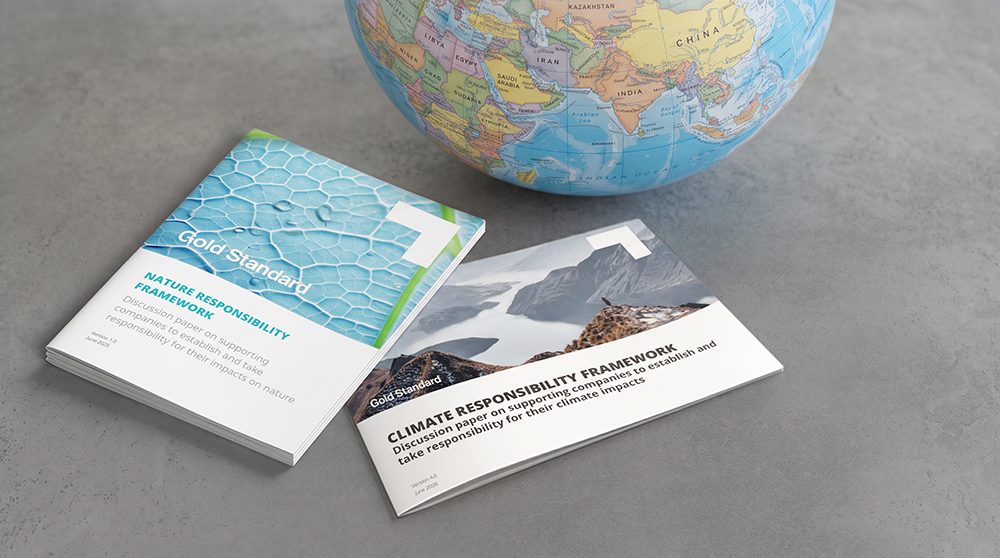
Version 4.0 of the Climate Responsibility Framework was published in June 2026. It is updated every year, used together with the “Four Stages to Climate Leadership” self-assessment tool, and complements the rules of the Science Based Targets initiative (SBTi), the Greenhouse Gas Protocol (GHG Protocol) and the World Wide Fund for Nature (WWF). According to Dan Magrath, Gold Standard's head of corporate best practice, the new version has four key points:
Two emission reduction pathways
Emission reductions are split into two pathways: “physical reductions” and “non-direct reductions”. The latter applies where supply sources are hard to trace — for example, a food company buying from thousands of smallholders can act within an “activity pool” in the same sourcing region, setting targets over five-year cycles and reporting separately from physical reductions.
A new definition of net zero
Net zero is redefined as a company's “contribution” to the global goal, rather than neutralising the organisation's own emissions.
Ongoing Emissions Responsibility
“Ongoing Emissions Responsibility” (OER) replaces “Beyond Value Chain Mitigation” (BVCM).
Removals and short-lived forcers
Carbon dioxide removal (CDR) takes a portfolio approach, and early action on short-lived climate forcers (SLCFs) such as methane is encouraged.
Smallholder supply chains in Hualien and Chishang are the most fitting application of the “activity pool” idea: what a company buys is not just rice, but a supply chain that can be traced year by year and decarbonised step by step.
What a company buys is not just rice, but a supply chain that can be traced year by year and decarbonised step by step.
Nature responsibility: five responsibilities — and no claiming to be “nature positive”
Version 1.0 of the Nature Responsibility Framework was published in June 2025, co-written by Gold Standard and Shared Planet. Following the Science Based Targets Network (SBTN) action hierarchy of “avoid and reduce, restore and regenerate, transform systems”, it sets out five responsibilities:
- Capacity building, governance, assessment and disclosure
- Minimising harm across the value chain
- Impacts and contributions at local and landscape scale
- Contributions at system and global level
- Claims and communication
The framework explicitly cites “using regenerative agriculture to improve soil health and sequester carbon” as an integrated solution for climate and nature. It also cautions that no single company can call itself “nature positive”; it can only say it “contributes” to nature-positive goals. Voluntary biodiversity credits (VBCs) may not be used as offsets, and spending on promoting nature actions should not exceed the amount actually invested in them.
A good soup stands up to lifting the lid
The three documents point the same way: companies' money should be spent where results can be seen, measured and clearly explained, and they must first cut their own emissions. Just as a good soup relies on real ingredients, credible climate and nature action stands up to having the lid lifted. Companies, schools and consumers are welcome to book a visit to the fields of Chishang and Hualien — have a bowl of hot soup, taste the new rice of the Start of Winter, see how regenerative farming nourishes the soil, sequesters carbon and feeds people all at once, and take a food and farming education class. Bookings and enquiries: [email protected]|0906-892-567
Sources
- Margaret Kim & Damilola Ogunbiyi, How trade policy could help finance the energy transition, Gold Standard (updated 26 October 2026) https://www.goldstandard.org/news/how-trade-policy-could-help-finance-the-energy-transition
- European Commission, CBAM successfully entered into force on 1 January 2026 (14 January 2026) https://taxation-customs.ec.europa.eu/news/cbam-successfully-entered-force-1-january-2026-2026-01-14_en
- Gold Standard, Climate Responsibility Framework v.4.0 (18 June 2026) https://www.goldstandard.org/publications/climate-responsibility-framework-2026
- Dan Magrath, Contributing to global net zero: preparing for the next phase of corporate climate action, Gold Standard (18 June 2026) https://goldstandard.org/news/contributing-to-global-net-zero-preparing-for-the-next-phase-of-corporate-climate-action
- Gold Standard & Shared Planet, Nature Responsibility Framework v1.0 (June 2025) https://goldstandard.org/publications/nature-responsibility-framework


