 努力小農
本文尚無譯文。
Passing the sustainable value of smallholders' carbon farming on to every consumer's plate
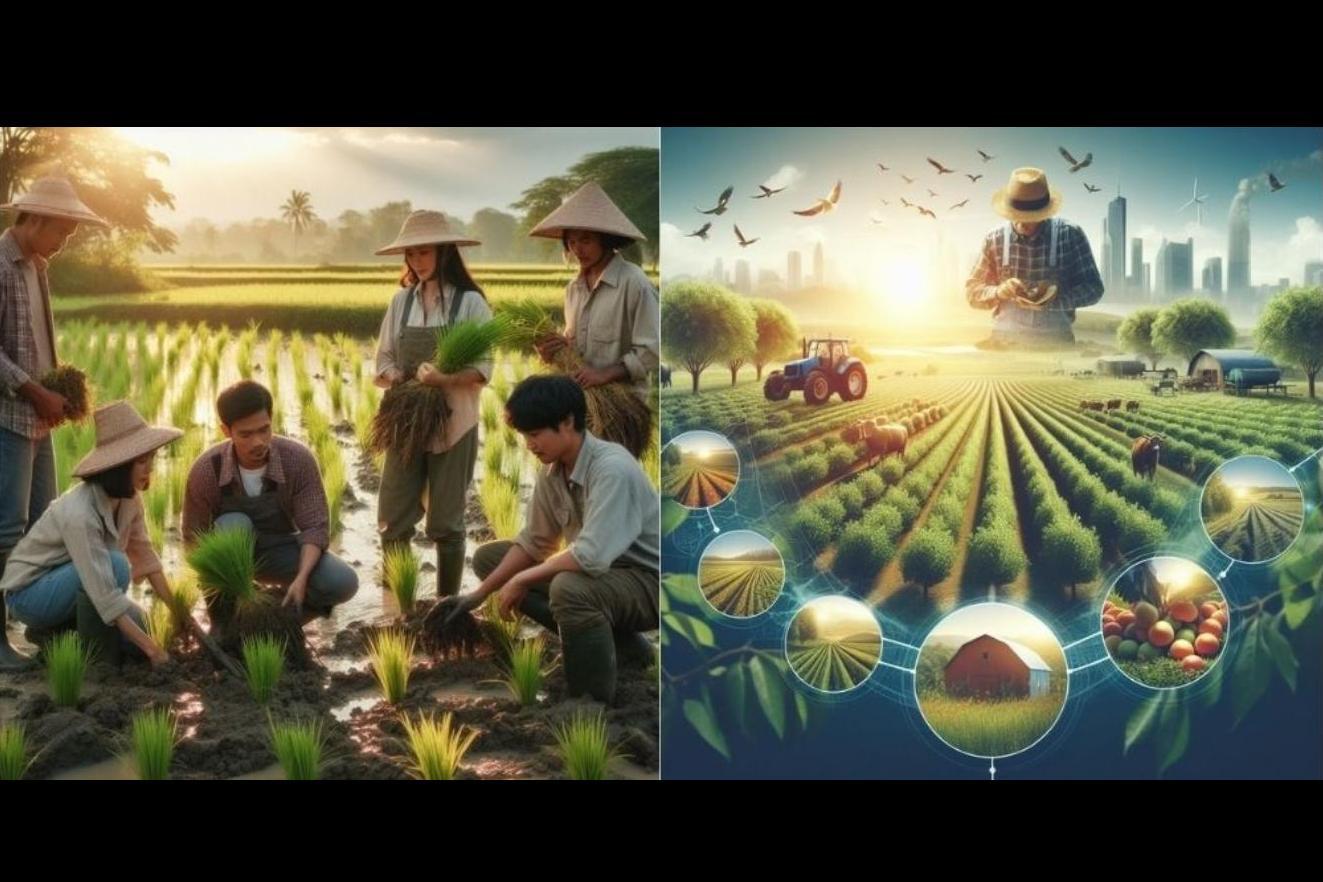
Smallholder carbon farming can be carried out on farmland growing all kinds of cash crops. Its main purpose is to help smallholders show the sustainable value of their work and turn it into real income. (Image: provided by Jay Fang, generated with DALL-E 3)
As the Taiwan Smallholder Carbon Farming Project gradually becomes complete and mature, products from farmers' carbon farming will soon be able to carry the "sustainable development label" authorised by the international emission-reduction certification body the Gold Standard, with traceable production and sales records for labelled products. The label can also be passed down the food supply chain, ultimately carrying the sustainable value of smallholders' carbon farming into every consumer's hands and mouths.
Looking ahead to future sustainable value
The 1992 UN Framework Convention on Climate Change (UNFCCC) set the aim of "mitigating climate change caused by greenhouse gases" in order to achieve sustainable social and economic development for humanity. Over the following 23 years, the financial means of mitigating greenhouse gas emissions created through the Clean Development Mechanism (i.e. carbon trading) ultimately failed. CDM carbon trading ended in 2021, leaving behind hundreds of millions of tonnes of emission reductions (carbon credits) that could not be traded because of lost trust — earning an international reputation for greenwashing that persists to this day.
Based on 1992's Agenda 21, in 1999 the UN Development Programme (UNDP) put forward the eight Millennium Development Goals for the 15 years from 2000 to 2015, and in September 2015 the 17 Goals of the 2030 Agenda for Sustainable Development for 2015 to 2030, which became the "Sustainable Development Goals".
(Note: in Chinese these are usually translated as 永續發展目標 ("targets"), but the original is "Goals", which should be rendered as 目的 ("aims"), because under each Goal there are Targets, and under the targets there are Indicators. So in the Chinese original of this article we use 永續發展目的 to distinguish them from the targets and indicators below them.)
The Sustainable Development Goals have a "shelf life": to achieve the 2030 Goals, they must be reached through targets and indicators. So sustainable development should look ahead to 2030, with progress on targets and indicators completed each year. Yet most "sustainability reports" on the market are companies' and agencies' retrospective exhibitions of past "good deeds", betraying the intent of the Sustainable Development Goals.
In November 2015 the 21st UN Climate Change Conference (COP 21) was held in Paris and the Paris Agreement was signed. It also invoked the Sustainable Development Goals and set the aim of reaching net zero by 2050 to keep global temperature change within 1.5°C (more ambitious than the 2°C of the 1997 Kyoto Protocol). Article 6 of the Agreement provides that Parties' nationally determined contributions must include voluntary emission reductions to advance national progress, and Article 6.4 lays down rules on trading voluntary emission reductions, excerpted as follows:
A mechanism to contribute to the mitigation of greenhouse gas emissions and support sustainable development is hereby established under the authority and guidance of the Conference of the Parties serving as the meeting of the Parties to this Agreement for use by Parties on a voluntary basis. It shall be supervised by a body designated by the Conference of the Parties serving as the meeting of the Parties to this Agreement, and shall aim:
(a) To promote the mitigation of greenhouse gas emissions while fostering sustainable development;
(b) To incentivize and facilitate participation in the mitigation of greenhouse gas emissions by public and private entities authorized by a Party;
(c) To contribute to the reduction of emission levels in the host Party, which will benefit from mitigation activities resulting in emission reductions that can also be used by another Party to fulfil its nationally determined contribution; and
(d) To deliver an overall mitigation in global emissions.
So under the Paris Agreement's definition of voluntary emission reduction, Parties should encourage voluntary reductions and trading, and their performance should count towards nationally determined contributions. Voluntary emission reduction should also be combined with the Sustainable Development Goals.
The international voluntary emission-reduction organisation the Gold Standard was originally founded with funding from WWF, a leading international NGO driving global carbon reduction. Upholding the UNFCCC and the Paris Agreement, it readjusted its certification rules in 2016, and in 2022 announced that for emission-reduction project certification, besides the mandatory SDG 13, projects must show quantified performance on two or more further SDGs to be certified.
The Taiwan Smallholder Carbon Farming Project has been approved to achieve six Sustainable Development Goals and must set out a monitoring plan and report quantified performance. This year, because emission-reduction performance far exceeded expectations, we have applied to change it into a large-scale project reducing more than 60,000 tonnes a year, and must also propose changes to the project's Sustainable Development Goals.
In the previous article, "MiHuMiSang's gift for Earth Day 2024", we disclosed the cumulative ten-year performance of the six goals for 2023–2032. Following the 22 April Earth Day meeting and subsequent consultation meetings, we set out an outline of the estimates again below: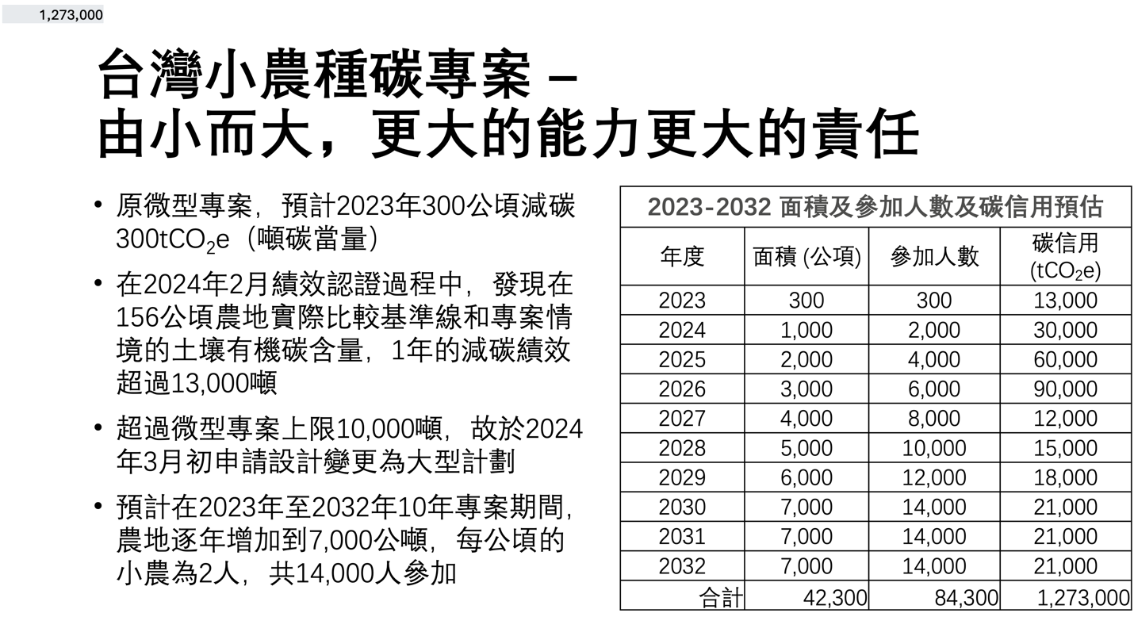
"Carbon rights" are the asset value of farmers' produce
After the first year of project implementation, field measurements of soil organic carbon on 156 hectares of smallholder carbon farming found both increases and decreases. After statistical analysis and conservative estimation, there was a total increase of 13,000 tonnes of CO2 equivalent, submitted to the Gold Standard; the final total will be determined by its technical expert committee. These preliminary results differ greatly from the original project design estimate, so we must propose a project design change to reflect actual emission-reduction performance, and also re-estimate the other SDG performance, the monitoring plan, additionality and so on, to ensure the project is correct and valid.
When people talk about "carbon rights", they usually mean only emission-reduction credits — "carbon credits" — completely ignoring the sustainable value of carbon reduction. Under the UNFCCC's REDD definition, "carbon rights" are: "Carbon rights refer to rights to the benefit streams from carbon sinks, such as those from a specific forest parcel. Where there is a market for greenhouse gas emission reductions, carbon rights may have financial value. Carbon rights may also define management responsibilities related to a specific forest area. Issues around carbon rights include how the rights are defined, how they operate where land tenure is unclear, and whether legal institutions are strong enough to protect them."
For agriculture, the financial value generated includes farm produce, income from carbon credit trading, and other quantified SDG sustainability-impact performance. All farmers' produce comes from photosynthesis absorbing CO2 from the air — it is carbon assets through and through.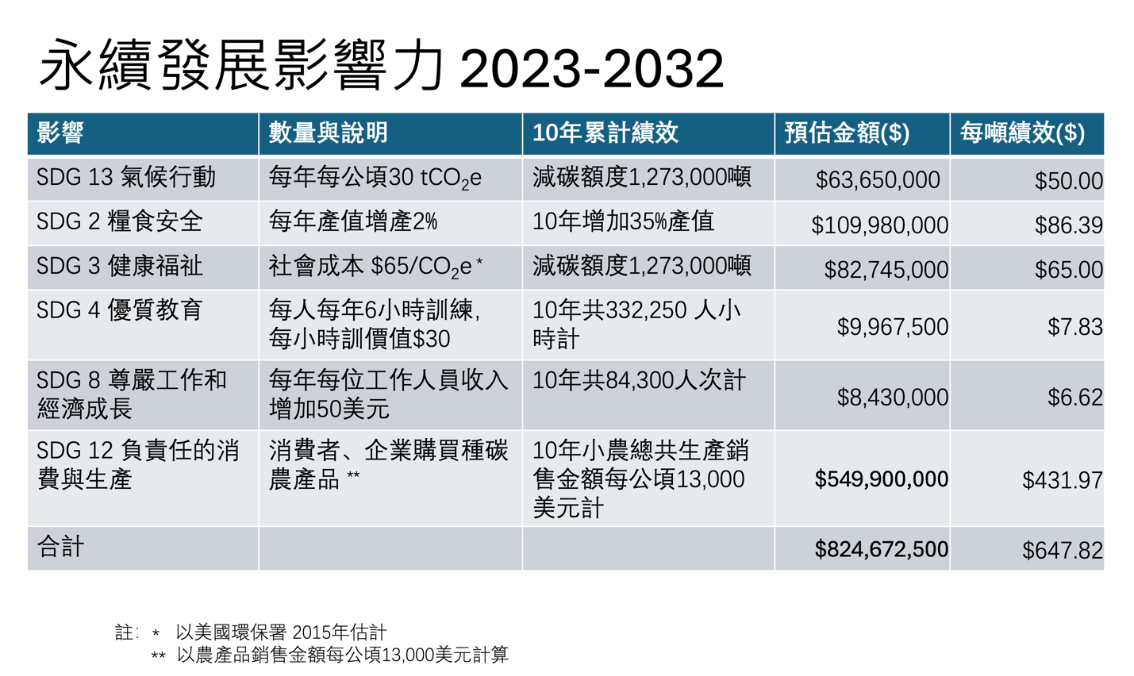
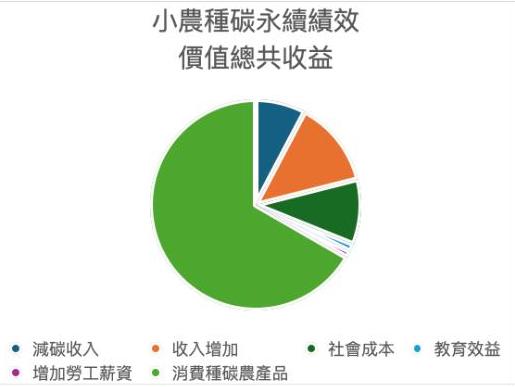
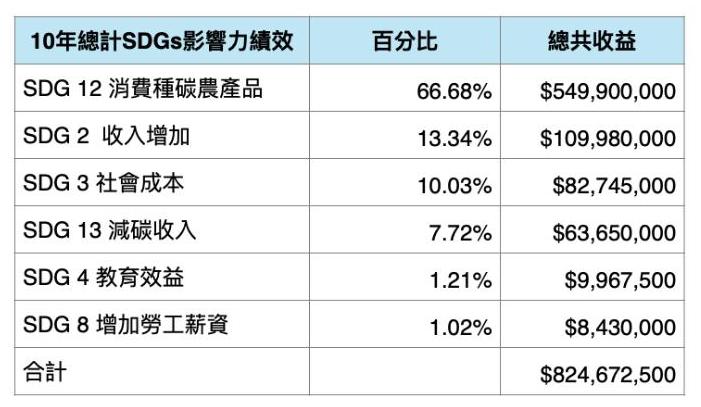
Using the Gold Standard's guidelines for estimating sustainability-impact value, we estimate that over the ten years 2023–2032 the project can create US$824,672,500 of value in impact on sustainable development indicators. This also shows that the main source of income is not carbon credit revenue from emission reductions (only 7.72%), but consumption of carbon-farmed produce, which accounts for an absolute majority of two-thirds.
This also shows that agricultural carbon rights must come back to agriculture and its produce. In theory, farmland with increased soil organic carbon has healthy soil, producing healthy plants and so healthy people; both the quality and quantity of produce will improve. That is the most important value of sustainable, low-carbon agriculture.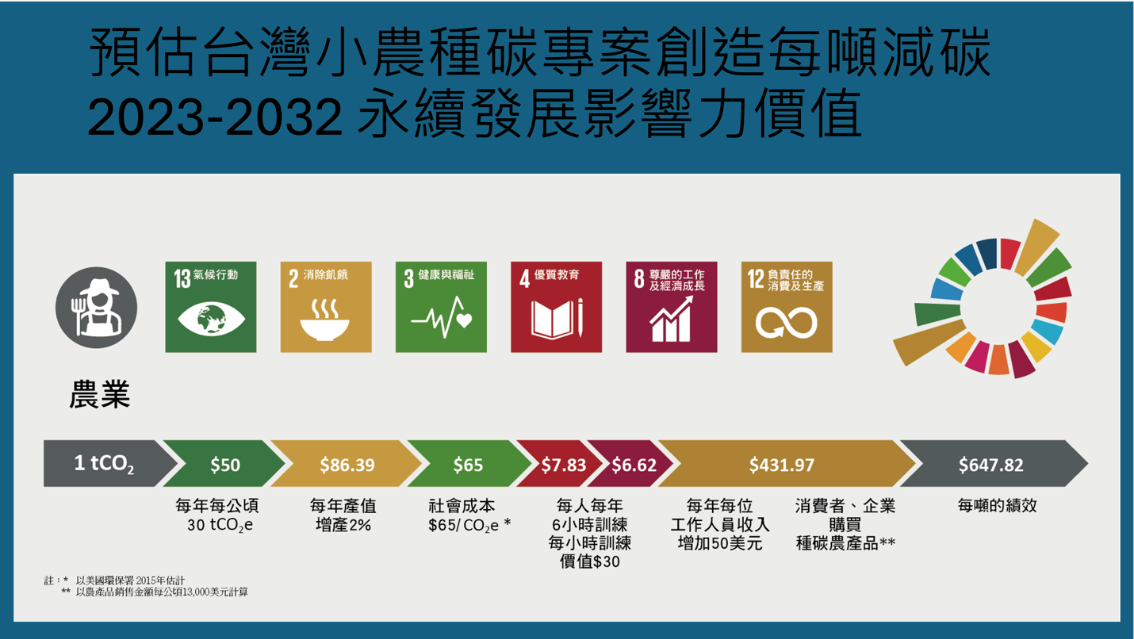
Preliminary estimates for smallholder carbon farming, converted to benefit per tonne of carbon reduction, reach US$647.82 per tonne, mainly from responsible consumption and production: the bottom line is that smallholder carbon farming products sell and smallholders' income increases. (Image: provided by Jay Fang)
Principle of international labels: every transaction should pass on sustainable value and increase smallholders' income
These estimates follow the Gold Standard's certification principles and requirements and the methods used to value sustainability in other types of projects, and will be monitored against progress and reported annually.
Because the Gold Standard is a member of the ISEAL Alliance (International Social and Environmental Accreditation and Labelling Alliance), products from projects whose design is certified by the Gold Standard can be labelled as certified (farm produce, SDG performance) according to the rules and promoted according to the Gold Standard's communication guidelines; sponsors and funders can also claim their contribution to sustainability under the guidelines' principles.
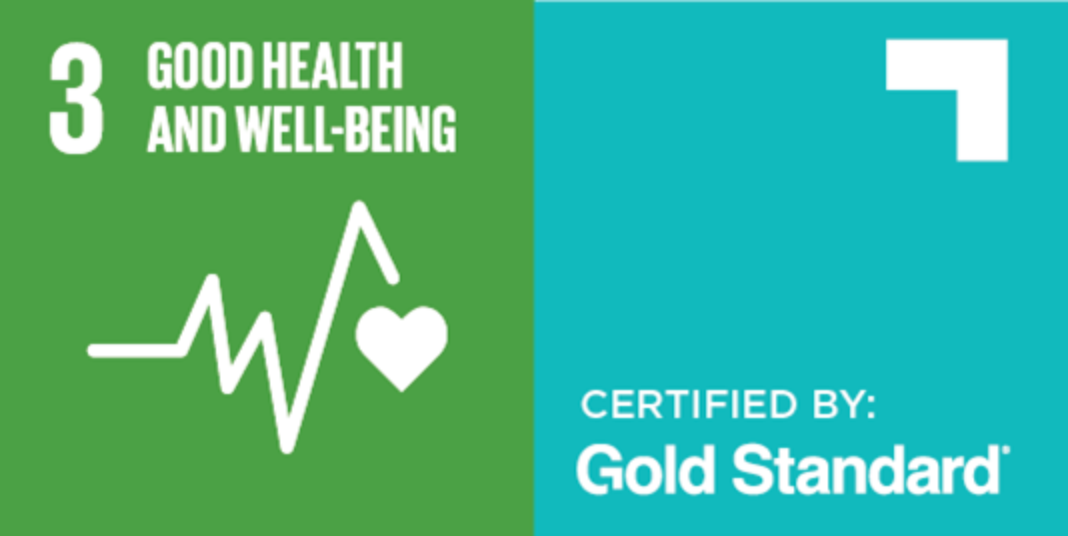
The Gold Standard's communication guidelines set out how to use sustainable development performance labels. (Image: from the Gold Standard communication guidelines)
The Gold Standard authorises project developers to use and manage the labels according to the guidelines. In future all carbon-farmed products must be labelled according to the rules. For example, rice from Changliang Village in Yuli, Hualien, which reduced about 12,000 tonnes of CO2 equivalent in 2023, can carry the six related emission-reduction certification labels on its packaging, with a QR code linking to the smallholders who grew it and their MiHuMiSang records. This lets anyone trace the dynamic, real-time production records back to the smallholder source. Processed foods made mainly from Changliang rice can continue to use the label too.
For example, a company that buys and consumes Changliang rice is entitled to claim a contribution to carbon reduction and sustainability according to the amount of rice bought. By our estimate, 1 tonne of rice contributes 20 tonnes of carbon reduction; each bowl of rice, about 100 g, carries the value of 20 kg of carbon reduction, helping realise the value of SDG 13 Climate Action — which is also the company's SDG 12 value of responsible consumption and production. And if the company runs internal environmental and food-and-agriculture education so employees understand the meaning and importance of carbon reduction and eat as much domestic low-carbon rice as possible — ideally brown rice — it can gain the value of SDG 4 Quality Education, SDG 3 Good Health and Well-being and SDG 2 Zero Hunger, while raising smallholders' income for the value of SDG 8 Decent Work and Economic Growth. So the value of smallholder carbon farming's six SDGs carries on.
Of course companies can also give smallholder carbon farming produce and processed products as gifts to employees and customers, or donate them to charities in need, likewise expanding the impact value of smallholder carbon farming.
Companies can provide these continuing value and performance figures to the project developer to be included in the following year's project report as benefits under the project's sustainability performance indicators. For companies, this SDG performance can also count towards that year's ESG (environmental, social and governance) performance.
This system must guarantee smallholders' income, so anyone using the label must ensure part of the revenue is shared with the smallholders who produced it to be eligible — because under ISEAL's rules, label users must ensure smallholders' livelihoods. We must make sure that with every sale and processing step of smallholders' products, the impact of their contribution to sustainable development is passed on again, so as to expand the impact of smallholders' sustainable contribution.
We believe this will multiply the impact of the original value of more than US$800 million, spreading it to every corner of society. This depends on the participation and support of the public and private sectors to keep sustainability going.
The bottom line is to let smallholders' produce and labour, and their contribution to the ecological environment, continue steadily over the long term — relying not on moral persuasion but on real economic growth and income.
About: MiHuMiSang and the Taiwan Smallholder Carbon Farming Project
The first-year results of the Taiwan Smallholder Carbon Farming Project exceeded our expectations — surpassing the micro-scale project's 10,000-tonne annual limit — so we must apply to the Gold Standard to become a 60,000-tonne-a-year project.
To make this change, we must follow the application procedure under the Gold Standard's Principles & Requirements. The most important step is holding a Stakeholder Consultation Meeting to explain to the public and stakeholders the reasons for the change and the future requirements and changes in project development.
Stakeholder consultation meeting registration form: https://forms.gle/fnTmwhdyg7fpCjSF8
Time: 2 p.m., 22 April 2024 (Earth Day)
Venue: 2F meeting room, Huwei Farmers' Association, Yunlin (197 Guangfu Road, Huwei Township, Yunlin County)
Applications to join in the second year will therefore open on 1 May this year; we are not accepting them for now.
As the project will become a large-scale project, the participating farmland should total several thousand hectares. Everyone is welcome to join voluntarily.
Farmland must meet the Gold Standard's farmland requirements:
Legal farmland — agricultural and pastoral land (with proof of lawful use, such as a lease or letter of consent)
Agricultural operation (not just growing for your own consumption), with more than 10 years of cultivation history and records of harvests and income for the past 5 years (report production and income for the past 5 years)
Must not be forest land or a non-developable area (such as protected areas, forest compartments, wetlands, ecologically sensitive areas, etc.)
Land area must be over 1,000 square metres (over 300 ping)
Growing crops (grains, fruit trees, flowers, Chinese medicinal herbs, etc.), mainly in open fields. Protected cultivation must be confirmed on site; soilless cultivation is not allowed.
Welcome to join the international certification of smallholder carbon farming — Taiwan's first agricultural emission-reduction project successfully registered with the Gold Standard for international emission reduction.
Public registry URL: https://registry.goldstandard.org/projects/details/3996
For notes on how to take part in smallholder carbon farming, just follow the 6 steps in the introduction one by one.
https://mihumisang.org/web/carbon_detail.php?ID=0rvz68w3shdvrcys
If you are interested in joining, please fill in the "Taiwan Smallholder Carbon Farming Project application assessment form"
https://forms.gle/fC5frqeXwJyQ6uqHA
For more news about MiHuMiSang and smallholder carbon farming, see
MiHuMiSang website: MiHuMiSang.org
MiHuMiSang column on CM Media: CM Media https://www.cmmedia.com.tw/home/author/159


