 努力小農

本文尚無譯文。
How to join carbon farming

Thank you for wanting to join the Smallholder Carbon Farming Project. For the project's features, see this video -->Smallholder carbon farming project features
Eligibility for carbon farming
-
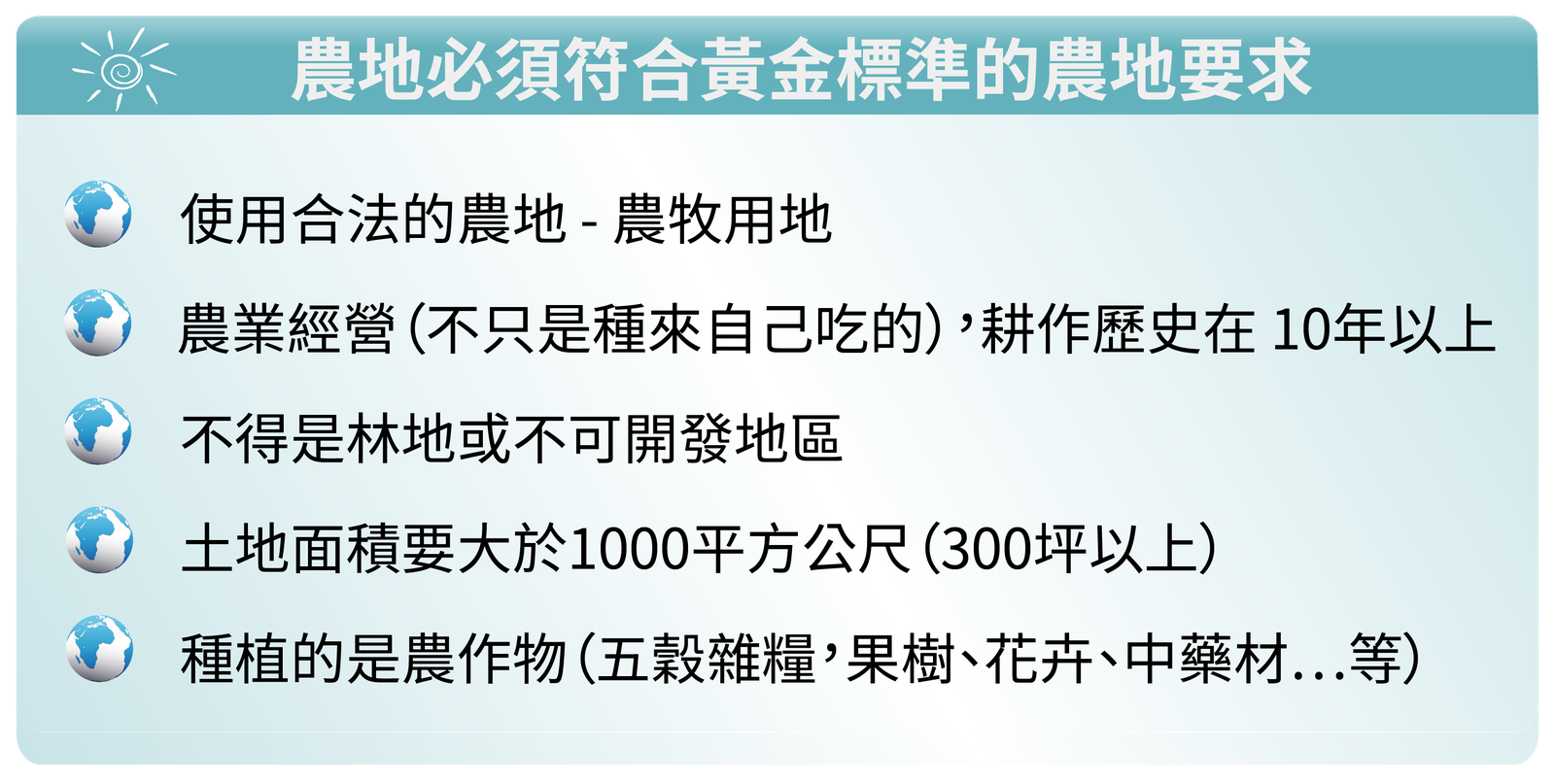
Farmland must meet the Gold Standard's farmland requirements:
- Legal farmland – agricultural/livestock land (with proof of legal use, such as a lease or letter of consent)
- Farming as a business (not just growing for your own consumption), with a farming history of over 10 years,
and harvest and income records for the past 5 years (report production and income for the past 5 years) - Not forest land or land that cannot be developed (such as protected areas, forestry compartments, wetlands, ecologically sensitive areas)
- Land area greater than 1,000 m² (300 ping or more)
- Growing agricultural crops (grains, fruit trees, flowers, medicinal herbs, etc.), mainly cultivated in the open;
protected cultivation must be confirmed on site, and soilless cultivation is not allowed
- The contract term is ten years, during which farming must continue. If farming stops for any reason, the contract must be terminated.
- No signing fee and no termination fee.

After installation, please fill in all the basic information first, to make subsequent carbon farming matters easier.
For detailed installation/registration videos, see this -->MiHuMiSang app tutorial videos

1) To join the carbon farming project, the farmland must be eligible, and relevant data for the past 5 years must be collected (the baseline).
--》Smallholder carbon farming baseline data sheet
--》Smallholder carbon farming project implementation sheet
2) Fill in the "Smallholder Carbon Farming Project registration form" online.
--》Smallholder carbon farming project registration form
3) Contact Mr Jay Fang (0932-030-973) to arrange a site visit.
4) If all requirements are met, the project contract can be signed. There are no fees, and the term is ten years.
For detailed information, see -->Smallholder carbon farming is really simple (Part 1)、Smallholder carbon farming is really simple (Part 2)

Before carbon farming, soil sampling must be done first. Open the app and take photos at the sampling points to keep a record.
Then send the soil to your local District Agricultural Research and Extension Station to test its organic matter content.
Agricultural carbon sink sample testing application form -->application form
For detailed sampling methods, see this -->Soil sampling method for smallholder carbon farming

Before you start carbon farming, think through the year's work: when you plan to prepare the land, raise seedlings, harvest and so on,
then open the app, switch to smallholder mode and schedule these on the production calendar.
For how to create a schedule, see this video -->MiHuMiSang work scheduling guide

Once you have a schedule, record your actual work as you farm — take photos and write diary notes — to keep a record of the carbon farming process.
For how to write a diary, see this video -->MiHuMiSang – smallholder diary guide

After a year of hard work with carbon farming methods, the soil's organic matter changes. Sample and test it again to calculate the carbon sink.
The carbon sink then goes through the verification procedures of a carbon offset mechanism to turn it into carbon credits.
Related articles -->
▶ Towards 1,000 hectares of smallholder carbon farming & FAQ (Part 2)
▶ Finally through... towards 1,000 hectares of smallholder carbon farming & FAQ (Part 1)
▶ The carbon farming project has grown! Taiwan's smallholders achieve over 10,000 tonnes of carbon farming in one year
▶ Refining diamond-grade carbon credits together
▶ Farmers' livelihoods in a just climate transition
▶ A few things about the Gold Standard carbon credit certification audit process
▶ Bringing the sustainable value of smallholder carbon farming to every consumer's table
▶ The SDG and ESG meaning of the Changliang Radish Festival
▶ The "first metre" of carbon reduction and net zero: Changliang, Hualien, a promised land for agricultural carbon reduction
▶ Investing in smallholder carbon farming: a just transition for agriculture
▶ A century-long plan typhoons can't blow away: Changliang's first metre of international carbon reduction certification
▶ Taiwan's agricultural carbon reduction methodology strides ahead
▶ Getting rich from carbon reduction? 9 myths about carbon credits
▶ Life is the foundation of carbon storage: land must be alive to be organic
▶ A key role in carbon trading: the project developer
▶ A remote Taiwanese village becomes an international carbon reduction hub: Changliang's smallholder carbon farming takes its first metre
▶ One month to the carbon exchange's opening: is Taiwan ready?


