努力小農
A drop of oil at a thousand times the cost
本文尚無譯文。
A drop of oil at a thousand times the cost
Taking apart the real bill for Chung Lien's salad oil with the cost of quality, HACCP and FMEA
Why this is a national-security-level crisis where finding it later costs a thousand times more
The previous article asked who should pay compensation and how. This one takes an engineering and management angle: if we treat this food-safety storm as a bill, how big is it? And the crueller question: this bill could have been prevented at a thousandth of today's cost — yet so far we have only seen the sheep lost, not the fence mended.
A harsh law of quality management: 1–10–100
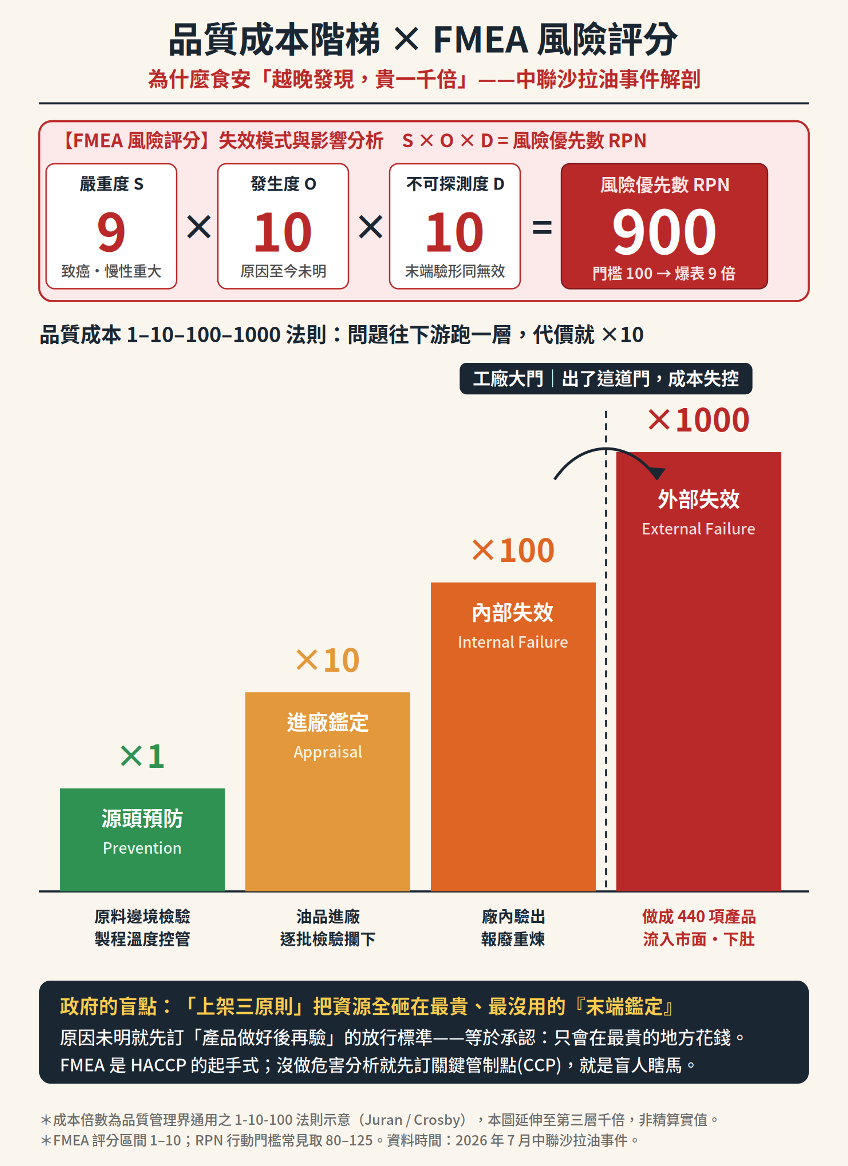
For half a century, quality management has used a concept called the Cost of Quality, or the Cost of Poor Quality. It divides costs into four blocks: prevention costs spent on checks beforehand; appraisal costs spent on inspection and measurement; internal failure costs when a defect is caught while the product is still in the plant; and external failure costs when the problem only surfaces after the product has been sold and reached the customer.
The industry's best-known rule of thumb is the 1–10–100 rule (associated with the quality pioneers Juran and Crosby): fixing a problem at the source costs 1; letting it into the plant and stopping it at incoming inspection costs 10; finding it only after it has become a finished product and reached the customer costs 100.
In this case we can add one more level: when the oil was not only sold but made into meals and actually eaten, the cost jumps to 1,000. Fit Chung Lien's supply chain into this and the picture is very clear:
In one sentence: the earlier an internal cost is dealt with, the lower it is; once a problem crosses the factory gate and becomes an external failure, the cost grows exponentially. The chart below is the skeleton of this article — take thirty seconds to read it first:
Scoring the storm: an FMEA score of 900
To judge how serious a risk is and whether to act immediately, engineering has a standard tool called FMEA (Failure Mode and Effects Analysis). It was first used by the US Air Force and NASA's Apollo programme — in space, any small failure can be fatal, so every possible failure mode has to be scored.
FMEA breaks risk into three dimensions, each scored from 1 to 10, and multiplies them into a Risk Priority Number (RPN):
Benzo[a]pyrene is an IARC Group 1 carcinogen — a serious hazard. Because it is chronic rather than causing sudden death without warning, the top score of 10 is reserved for the latter, so it scores 9.
Not a one-off batch accident: five batches and more than 5,000 tonnes so far. The authorities consider raw-material acceptance, processing and quality control likely to have systemic gaps, and the source is still unidentified — so it can only get the top score.
The current approach tests finished downstream products to infer whether the upstream oil was acceptable. End-of-line testing is highly unreliable and the chance of missing the problem is very high: full marks.
What exactly is wrong with the “three principles for returning to shelves”?
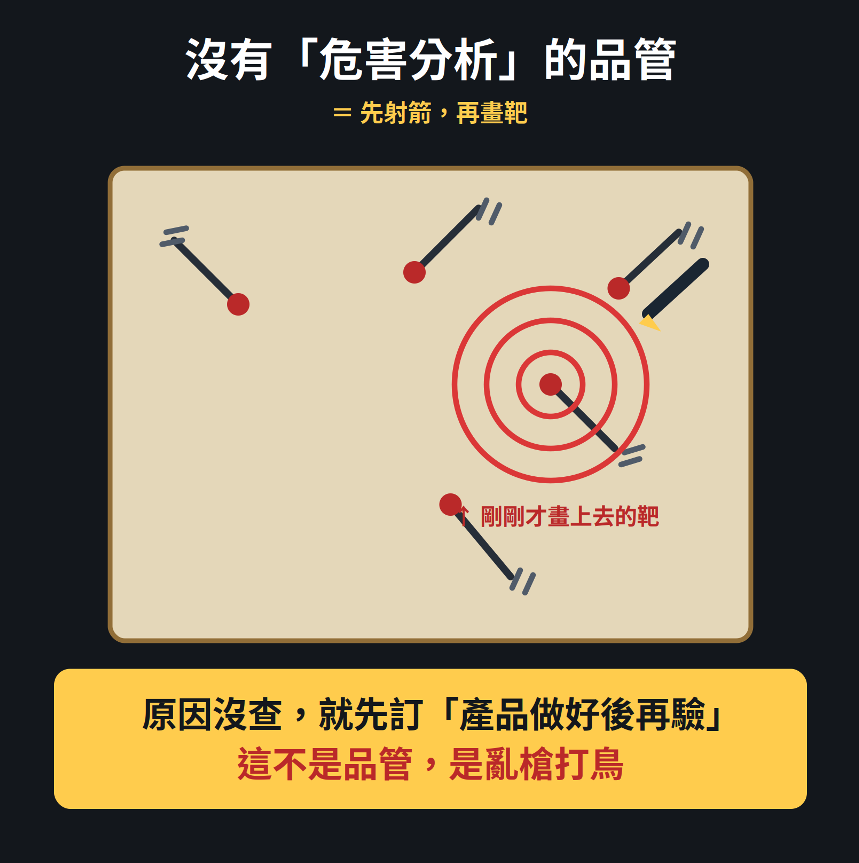
FMEA is really the opening move of HACCP (Hazard Analysis and Critical Control Points). The first of HACCP's seven principles is hazard analysis (HA): work out where the hazard comes from and how serious it is, and only then decide at which critical control points (CCPs) to apply checks.
Here is the problem: the source of the benzo[a]pyrene has not even been found (the HA has not been finished), yet the Executive Yuan and the Ministry of Health and Welfare have already announced “three principles for returning products to shelves” — all of them end-of-line tests that release products after they are made. That means setting CCPs before the HA is done, so the CCPs end up as shots in the dark.
FMEA is the opening move of HACCP
HACCP without FMEA is a blind man on a blind horse, wandering at random and liable to fall into a ravine, off a cliff or into a torrent at any moment.Why is end-of-line testing unreliable? One set of numbers makes it clear:
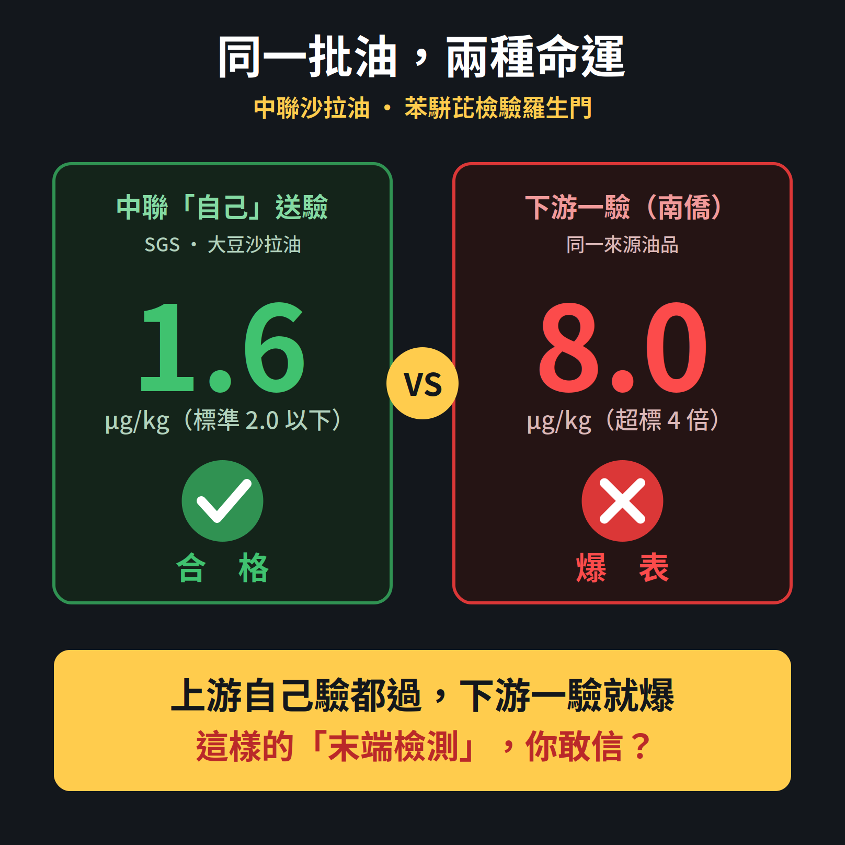
The same batch, two fates. The gap comes down to dilution and false negatives from sampling: the 27,500 tonnes of oil Chung Lien produced from April to June were bottled and processed into 440 products, diluting the concentration, so the odds that batch sampling happens to pick “the scoop that exceeds the limit” are very low. Moreover, most downstream processes don't involve heating, so they do not “add” benzo[a]pyrene — the problem was created in Chung Lien's process and carried into the oil, and what end-of-line testing can detect is only a diluted trace. Putting the checkpoint at the most expensive place with the lowest hit rate is the worst move in the cost of quality.
Counting the full bill: an industry tsunami starting at NT$275 billion
To be clear: what follows is a scenario estimate of value at risk, not GDP that has already evaporated. The point is not to frighten but to show the order of magnitude — why this is far more than a NT$165 million fine.
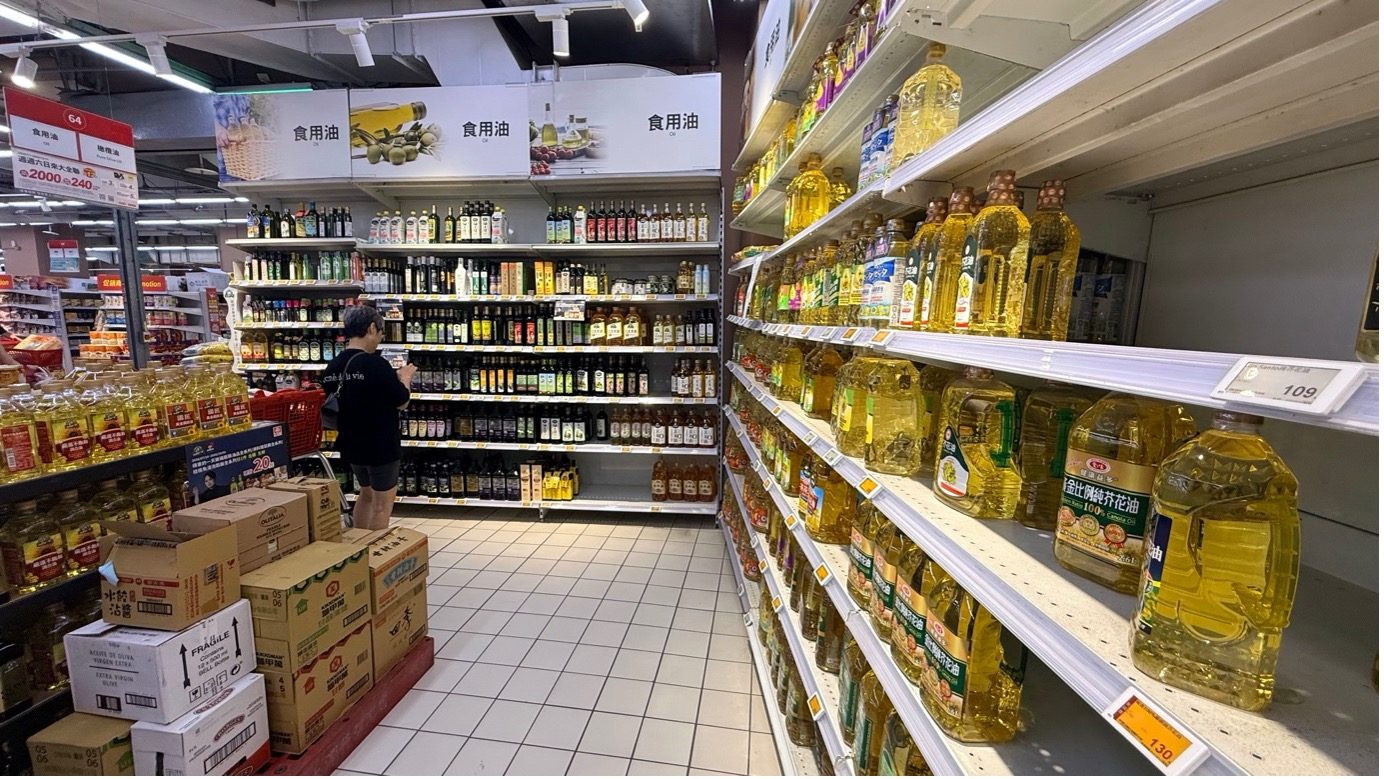
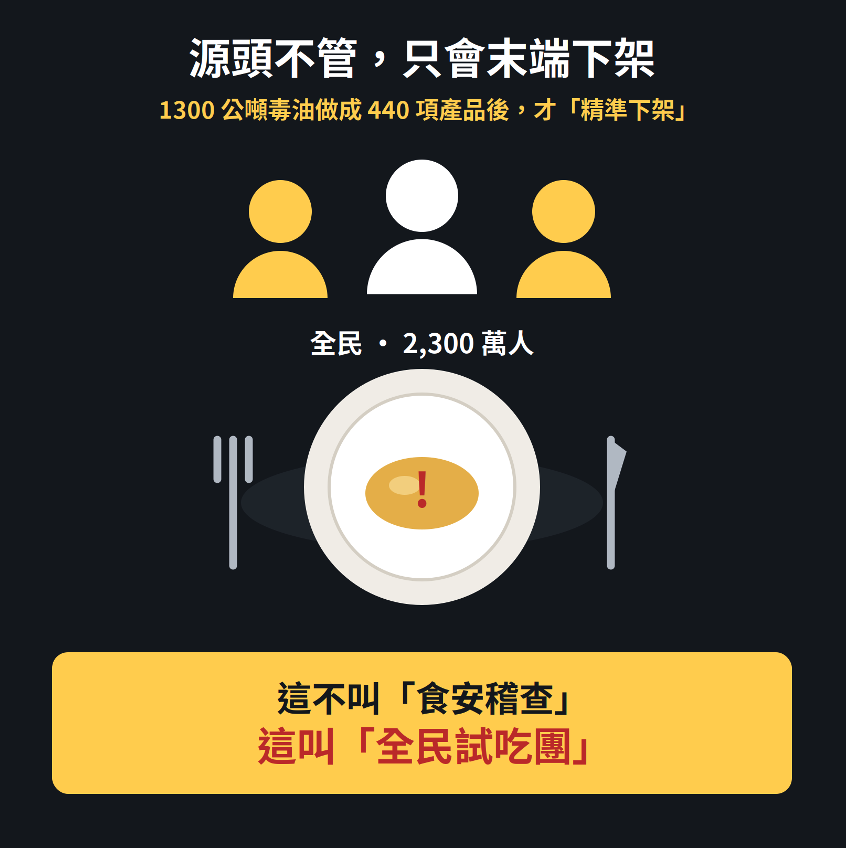
Salad oil is a basic ingredient for restaurants and food processing. When the raw material at the source goes wrong, the truly devastating cost is the huge sunk cost and lost business tied up in what has already been made into meals and processed foods. According to the Food and Drug Administration, Chung Lien produced 29 batches of soybean salad oil from April to June, about 27,500 tonnes in total (27,532.7 tonnes), all included in the precautionary withdrawal:
| Shipped to | Volume (tonnes) |
|---|---|
| Fwusow Industry | 9,674.7 |
| Formosa Oilseed Processing | 10,246.9 |
| Taisun Enterprise | 7,611.1 |
Assuming each meal uses 10 grams of oil on average, this oil could make about 2.75 billion meals or processed food portions. Shared among 23 million people, that is about 120 meals each — 40 days of eating out three meals a day. At NT$100–200 per meal, the market value is as follows:
| Price per meal | Total value at risk |
|---|---|
| NT$100 | About NT$275 billion |
| NT$150 (midpoint) | About NT$413 billion |
| NT$200 | About NT$551 billion |
Taiwan's central government budget is about NT$2.8–3 trillion a year. In other words, the value at risk in meals alone is equivalent to 9% to 20% of the national budget evaporating. This is what a “1,000×” external failure cost feels like in the real world. The gap between internal and external costs is clearest in a table:
| Aspect | Internal cost (solved inside the plant) | External cost (out of the factory gate) |
|---|---|---|
| Where it happens | Factory process / incoming inspection | Consumer market / dining table / human body |
| Unit cost | Low (×1 to ×100) | High (×1000 and up) |
| In this case | Control the source, stop each batch, scrap and re-refine | Made into 440 products; full withdrawal and destruction, consumer refunds, class actions, collapsed reputation, export rejections |
| Controllability | Almost entirely in the company's hands | Almost impossible to recover (once eaten, there's no going back) |
The above are scenario estimates and qualitative comparisons, not official figures.
Reputation, exports and tourism (long-term losses hard to estimate)
Taiwan's proud reputation as a “food kingdom” is tarnished; even restaurants not affected will see business collapse as people avoid eating out. Exports of souvenirs and processed foods may face stricter checks and rejections abroad — losing face internationally — and that loss is not even counted here.Health costs — first, correcting a common panic
Unlike dioxin, benzo[a]pyrene does not build up in the body for long. It is metabolised and excreted fairly quickly — most of it within about two weeks in faeces and urine — and a single or occasional intake does not cause acute poisoning or directly cause cancer. So the real external cost of this storm is not “these few meals will give you cancer” (which is extremely hard to attribute epidemiologically and easily becomes scaremongering). It is that a near-monopoly core contract processor lost systemic control, forcing the whole population into exposure and proving the bankruptcy of the entire end-of-line checking system. That cost in trust is the most expensive and hardest to repair.As public health has it: “If you see one cockroach crawling in a restaurant, there are a thousand more hiding in the dark cracks.”
The collapse of social trust: when people find that even a NT$100 lunch box or a NT$200 set meal cannot free them from fear of cancer, that sense of deprivation and anxiety cannot be calmed by any single minister stepping down.
So how can consumers protect themselves?
The most honest answer grows straight out of the cost of quality: once a meal has been eaten, the external failure has already happened. Personal “self-protection” is essentially appraisal at the very end of the end of the line — the most expensive and least useful. You cannot tell the source of oil with your eyes or tongue; the government cannot do it well even with the whole Food and Drug Administration, let alone an individual. Accepting this harsh fact is actually the most important first step.
Given that, here is what you really can do, limited as it is:
- Spread your exposure: don't rely for long on a single oil or a single source of eating out; spread the risk.
- Mind your own stove: the biggest everyday source of benzo[a]pyrene is actually grilling, smoking and over-browned frying — the one “critical control point” you control 100%. Rather than panic, eat less charred food.
- Let your body do its job; skip the detox fads: drink plenty of water, eat a balanced diet and plenty of antioxidant-rich vegetables and fruit. There is no need for stomach pumping or folk remedies.
- Keep evidence and claim refunds (following on from Part 1): this does not protect you from harm, but it sends the external failure cost that has already happened back to the source.
But truly effective self-protection is collective and structural:
- Push external failure costs back to the source: use collective claims to “internalise” external costs. Only when a company's external failure costs really hurt does investing in prevention at source make financial sense — the policy version of the 1-10-100 rule.
- Demand that the system return to the source: traceability (searchable batch numbers), mandatory third-party reporting, and mandatory testing of raw materials at source and at the border — moving public money from the most expensive end-of-line appraisal back to the cheapest and most effective prevention at source.
Note: monetary figures in this article are scenario estimates of value at risk, not realised losses; cost multiples illustrate the 1-10-100 rule commonly used in quality management; FMEA scores are the author's judgement based on public information. Event data are as of July 2026; later announcements by the authorities prevail.