 努力小農
Eat like a certified rice taster: tasting procedures in Japan and Taiwan revealed
本文尚無譯文。
Eat like a certified rice taster
Tasting procedures in Japan and Taiwan revealed
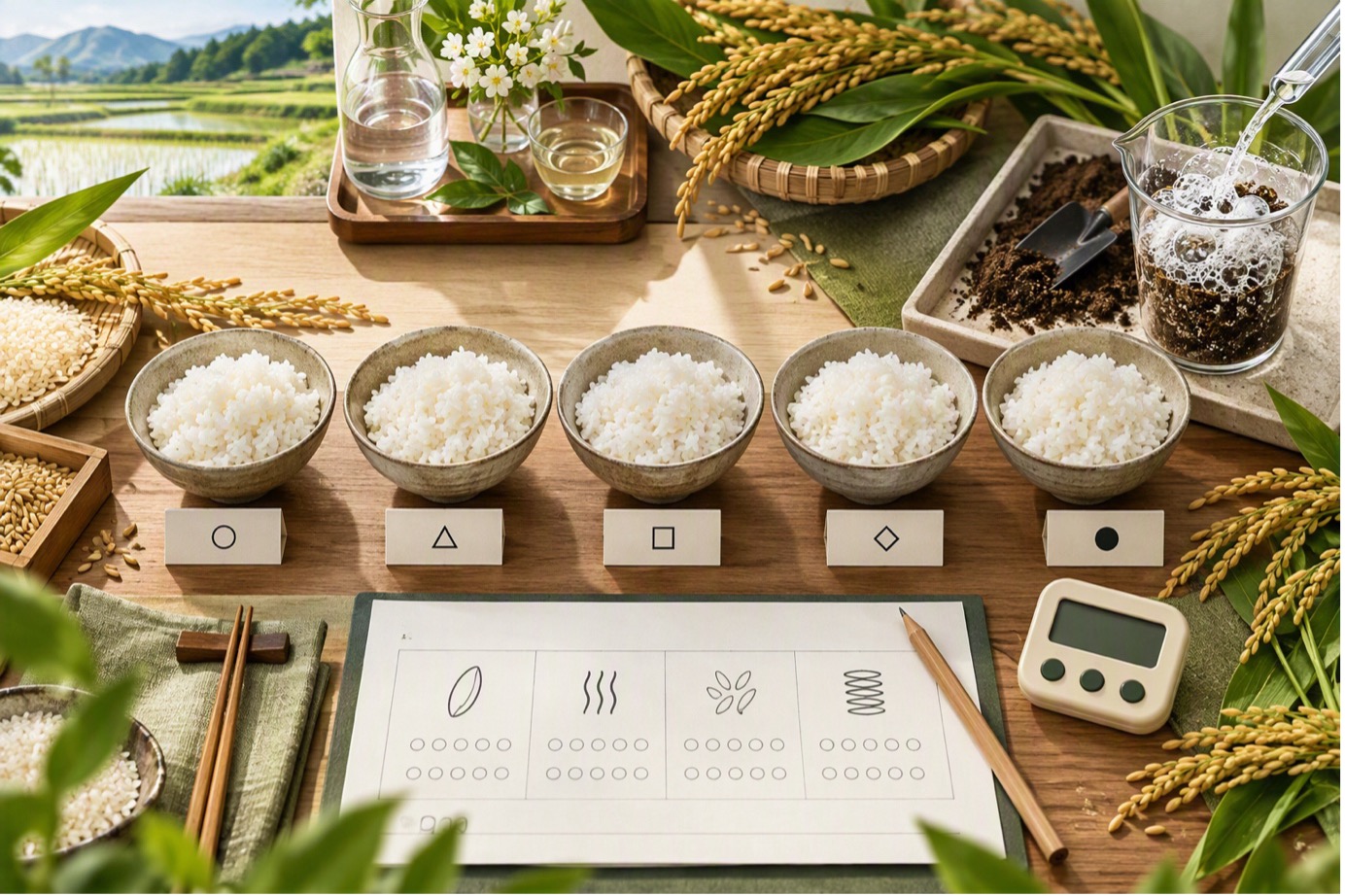
Want to tell good rice from bad in one mouthful, like a professional rice taster? In fact, from Japan's national-level rankings to the consumer tastings we hold beside the paddies, the whole process of “tasting the difference” is far more methodical — and more fun — than you might think.
OUR SOPThe carbon farming platform's consumer tasting SOP
Let's start with how we do it. Every consumer taste-value tasting run by the carbon farming platform follows a simple but rigorous SOP. Step one, “blinding”: all rice entries have their brand, origin and price labels removed beforehand, leaving only a number. Step two, “equal cooking”: three to five identical rice cookers, with the same amount of rice and water, soaking time and washing method, so every bowl starts from the same line. Step three, “resting”: after cooking, the rice rests for about 10 minutes so moisture redistributes inside, avoiding judgements skewed by rice that is too wet and sticky straight from the pot. Step four, “blind voting”: participants taste each bowl in turn and pick “the tastiest bowl” by instinct — no discussion, no comparing packaging, just letting the tongue speak. Step five, “reconciliation”: only after voting ends do we reveal each rice's score measured beforehand by taste analyser, so everyone can check whether “the tongue's choice” matches “the instrument's score”. We call this process “voting with your mouth”.
- BlindingRemove brand, origin and price labels, leaving only a number
- Equal cooking3–5 identical rice cookers; same rice, water, soaking time and washing method
- RestingRest about 10 minutes after cooking so moisture redistributes
- Blind votingTaste in turn and pick “the tastiest bowl” by instinct — let the tongue speak
- ReconciliationReveal analyser scores to check whether “the tongue's choice” matches “the instrument's score”
JAPANJapan: the Rice Taste Ranking and Toku-A
So what does professional taste evaluation involve? In Japan, rice taste evaluation has developed for more than half a century. A credible grain inspection body runs the “Rice Taste Ranking” (okome no shokumi ranking), each year assembling a panel of professional tasters who have trained for years and whose sense of taste has passed repeated tests. All samples are blinded and always compared with a fixed “reference rice” (usually Koshihikari), scored item by item on five aspects — appearance, aroma, flavour, stickiness and hardness — and then judged on overall balance, finally receiving one of five grades: Toku-A (special A), A, A′, B or B′. “Toku-A” is recognised as the highest honour in Japan's rice world, and a point of pride for many prefectural farmers' associations. The most valuable thing about the system is that, year after year for decades, it has built up a huge reference database, giving its results great consistency and credibility.
Scored item by item on five aspects, always against a “reference rice” (usually Koshihikari)
TAIWANTaiwan: an evaluation system still growing
By comparison, Taiwan's taste evaluation system is still growing. Since 2001 the Agriculture and Food Agency has held the “National Rice Quality Competition”, combining taste analyser readings with sensory re-evaluation by a panel of agricultural experts, chefs and nutritionists, gradually building Taiwan's own local evaluation standards. However, Taiwan does not yet have a nationally unified, long-accumulated and highly credible grading brand like Japan's “Toku-A”, and few mechanisms for systematically training “certified rice tasters”. That is exactly what the carbon farming platform particularly wants to invest in: by continuing to hold consumer tastings and building a local taste-value database, letting more farmers and consumers take part in training Taiwan's own “tongue database” together.
Japan
- History
- More than half a century
- Method
- Long-trained professional tasters; blinded, compared with a reference rice
- Grading brand
- Toku-A, A, A′, B, B′; a huge reference database built up
Taiwan
- History
- National Rice Quality Competition held since 2001
- Method
- Taste analyser readings + sensory re-evaluation by experts, chefs and nutritionists
- Grading brand
- No nationally unified grading brand yet; little systematic training of certified rice tasters
Build a local taste-value database and train Taiwan's own “tongue database” together.
SOIL TESTHydrogen peroxide organic carbon test: five steps to check soil
Beyond tasting, we have also designed soil testing as an activity that is just as fun and just as structured. The standard procedure for the “hydrogen peroxide organic carbon test” goes like this. Step one, “sampling”: choose three to five sampling points in the paddy, dig soil from about 10 to 15 cm below the surface, mix well and take 10 grams as the sample. Step two, “reaction”: put the 10 g soil sample in a clear container and slowly add 20 ml of hydrogen peroxide. Step three, “observation and timing”: watch carefully how fast and how densely bubbles form in the first 30 seconds to 5 minutes, recording it on a simple four-level scale: no reaction, slight bubbling, moderate bubbling, vigorous bubbling. Step four, “comparison and recording”: set results from different plots and farming methods side by side to draw a “soil vitality map” for this particular land. Step five, “cross-checking”: compare the strength of the soil reaction with the taste-value score of rice grown in the same field, so participants can see for themselves the cause-and-effect link between “carbon farming” and “tastiness”.
- Sampling3–5 points; soil from about 10–15 cm below the surface, mixed, 10 g taken
- ReactionPut in a clear container and slowly add 20 ml of hydrogen peroxide
- Observation and timingWatch the speed and density of bubbles in the first 30 seconds to 5 minutes; record on a four-level scale
- Comparison and recordingCompare plots and farming methods side by side; draw a “soil vitality map”
- Cross-checkingCompare soil reaction strength with the taste value of rice from the same field
Four-level scale
TASTE IT YOURSELFReal understanding comes from tasting and feeling for yourself
Most important of all, real understanding comes only from tasting and feeling for yourself. Whether tasting rice or testing soil, the spirit behind these procedures is the same: turning a “goodness” that was invisible and hard to describe into evidence anyone can verify and taste for themselves.
into evidence anyone can verify and taste for themselves.
BOOK A TASTINGA certification journey from field to table
Bring your colleagues, students or customers for the full experience
If you would like to bring your colleagues, students or customers on a full journey through taste value and carbon farming certification, from the paddy ridge to the dinner table, please contact the carbon farming platform. Following the procedures above, we will plan a solid and enjoyable tasting event for you.
- Email[email protected]
- Phone0906-892-567


