Carbon Farming Seasonal Digest Minor Heat issue | 2026.7.7 | No. 2
|
|
|
|
Carbon Farming Seasonal Digest
|
|
|
|
Minor Heat 2026
7 July 2026 · No. 2
|
|
|
|
From Summer Solstice to Minor Heat: Europe's runaway heat, an air-conditioning boom, and why we must shift from mitigation to adaptation
|
|
|
01 Why companies need agricultural carbon sinks more now that the carbon fee is here
|
|
|
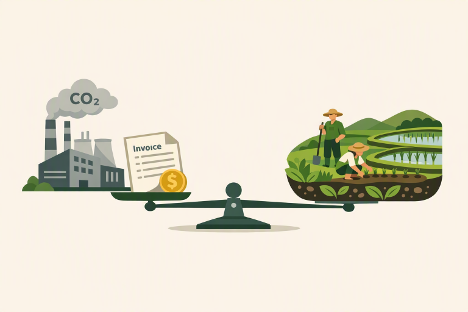
2026 is the first year Taiwan's carbon fee really bites. In 2025 companies only filed trial reports and paid nothing; from 2026, power and manufacturing companies emitting 25,000 tonnes or more a year (an estimated 500 emission sources at 281 companies) must pay a carbon fee based on their actual 2025 emissions. The standard rate is NT$300 per tonne; companies with an approved voluntary reduction plan that meet its targets can qualify for preferential rates of NT$50 or NT$100 per tonne — a sixfold difference. More importantly, the Ministry of Environment plans to raise the rate to NT$1,200–1,800 per tonne by 2030, so today's decisions will set a company's carbon cost curve for the next five years.
The carbon fee system also lets companies offset part of the fee with voluntary carbon credits: offsets from overseas credits are capped at 5% of chargeable emissions, while the offset ratio for domestic voluntary reduction and offset projects (including agricultural soil carbon sinks) will be announced separately by the Ministry of Environment. In other words, the earlier a company invests in domestic agricultural carbon sinks, the earlier it secures a place in this emerging reduction tool — one that stacks benefits for local supply chains, employee welfare and ESG disclosure, rather than just paying a carbon fee bill.
|
|
|
02 Knowledge corner: how the carbon fee is calculated, and where agricultural carbon sinks fit in
|
|
|
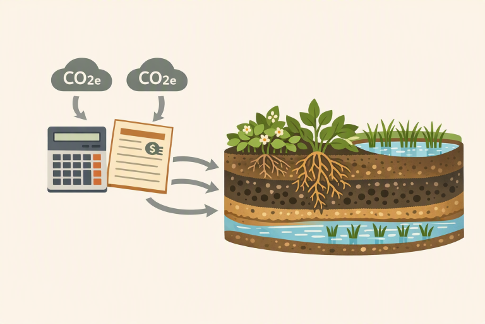
- Who pays: power and manufacturing companies with annual emissions (direct + indirect) of 25,000 tonnes or more.
- Rates: standard rate NT$300/tonne; companies meeting the targets of a voluntary reduction plan can apply for preferential rates of NT$50 or NT$100/tonne.
- Timeline: trial reporting with no payment in 2025; from 2026 the fee is paid on 2025 emissions; the rate is planned to rise to NT$1,200–1,800/tonne by 2030.
- Offsets: overseas voluntary credits capped at 5% of chargeable emissions; the ratio for domestic voluntary reduction/offset projects (including agricultural carbon sinks) to be announced separately.
- Agricultural carbon sink methodologies: the Ministry of Agriculture has approved the “Improved Agricultural Soil Management” (soil organic carbon) methodology; an organic cover-crop methodology is under review. Currently only companies and government agencies can apply for carbon credits, so smallholders take part through partnerships with companies.
|
|
|
03 Corporate action: why smallholder carbon farming + the ESG Green Shinkansen is the best choice for companies investing in agricultural carbon sinks
|
|
|
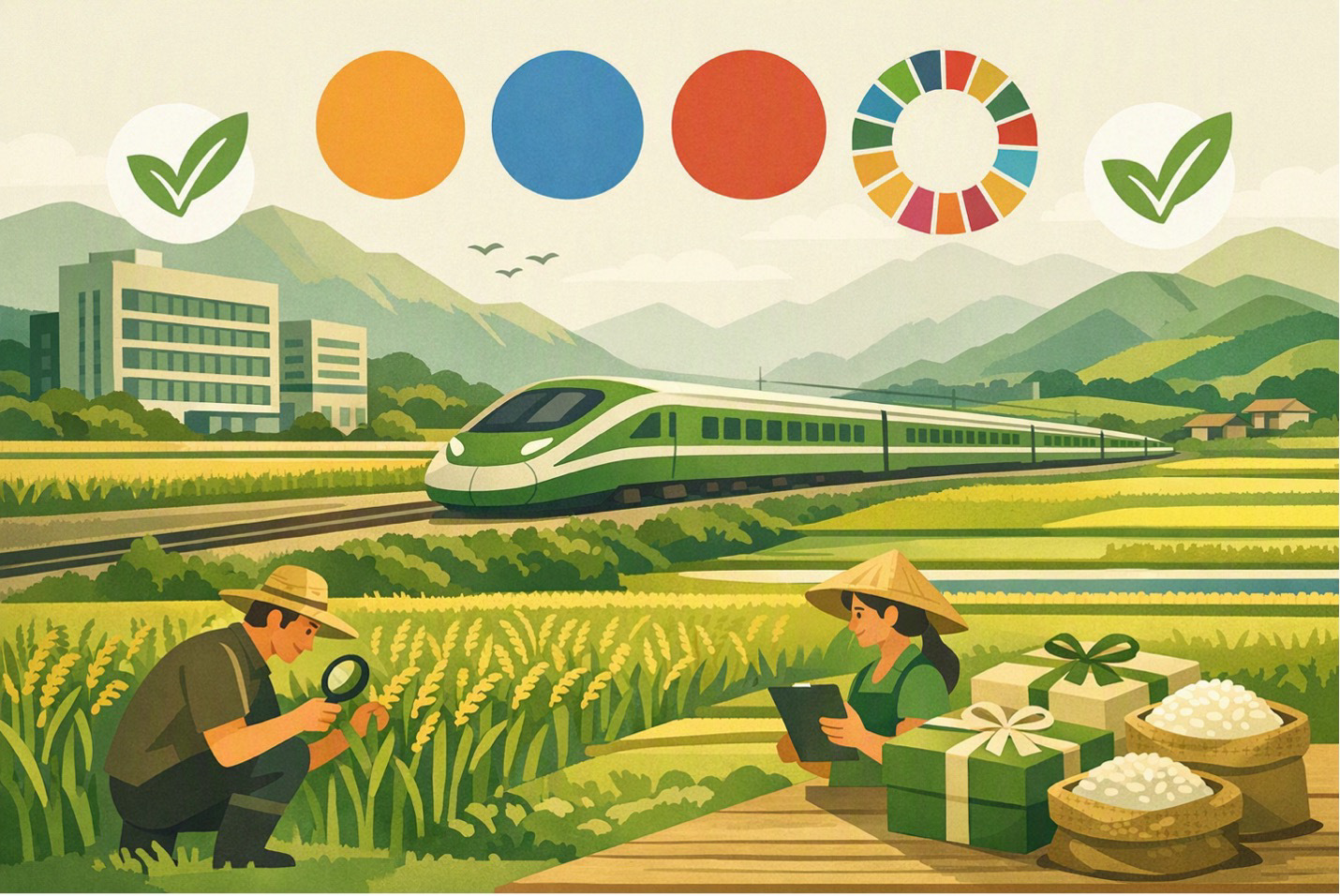
Once the carbon fee is in force, companies will find that offsetting the fee is not the only reason to buy agricultural carbon sinks. Through the ESG Green Shinkansen sandbox on the CARBON platform, a company investing in smallholder carbon farming in Hualien-Taitung receives not only Gold Standard-certified carbon credits (about 4 tCO₂e per hectare per year), but also six quantified SDG outcomes, premium Hualien-Taitung rice that can go straight into employee benefits, and a three-layer anti-greenwashing evidence chain — real-time records in the MiHuMiSang App → third-party VVB verification → public Gold Standard registry — so every investment can stand up to IFRS S2 disclosure scrutiny. Compared with buying credits of unclear origin and no local context on the market, smallholder carbon farming achieves carbon-fee compliance, ESG disclosure, local supply chains and employee welfare in one go, and over 70% of the investment goes straight into smallholders' accounts under PES contracts. It is currently the most practical and verifiable agricultural carbon sink option for companies.
|
|
|
|
|
04 The sandbox's legal framework: an introduction to the ESG Green Shinkansen four-party agreement
|
|
|
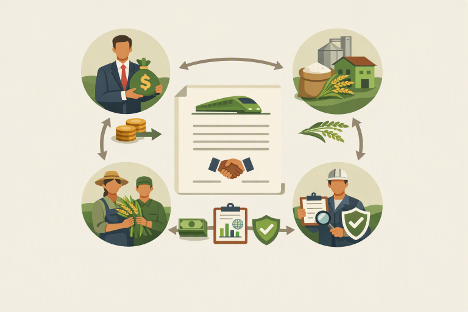
The “ESG Green Shinkansen Four-Party Sandbox Cooperation Agreement” (draft, 20 June 2026) is the legal backbone of this action plan, turning “smallholder carbon farming × corporate ESG investment × payment for ecosystem services (PES)” into an enforceable, auditable contractual relationship. It is built on the Gold Standard for the Global Goals framework and aims to align with IFRS S1/S2 disclosure requirements and the ESG evaluation criteria of Taiwan's Financial Supervisory Commission and Stock Exchange. Four parties sign it. Party A is the listed company investing in smallholder carbon farming. Party B is the smallholder groups who actually practise carbon farming: the Mitian Sharing Cooperative in Hualien, the second and third quality-rice production and marketing groups of Changliang, Yuli, and the Wan'an Community Development Association in Chishang. Party C is the agents linking smallholders to the market, such as Tianzu Sustainable Agriculture and the Chen Hsieh-ho rice mill, responsible for production and sales records and rice grading and pricing. Party D is Eco-affinity Inc., responsible for due diligence and project development, together with the Dawushan Cultural and Educational Foundation, an organisation of the international 4 per 1000 Initiative. At its core, the SDG/ESG outcomes of Party A's investment belong to the company and can be disclosed directly in its sustainability report; Party B or C supplies premium rice with a taste value of 65 or above, worth NT$100,000 at market price, for the company's employee benefits; and all parties sign PES contracts ensuring that over 70% of the payment goes directly to smallholders rather than being skimmed off layer by layer like a subsidy. The agreement also sets out a “five-layer impact framework”: layer 1 (ESG smallholders) and layer 2 (corporate procurement) are mandatory, while layers 3 to 5 (employee education, eco-tourism, supply chain expansion) are optional according to the company's needs. To prevent greenwashing, claims must follow the six integrity principles of the Gold Standard Claims Guidelines, with prior review, annual self-assessment, third-party VVB verification and whistleblower protection; if a party fails to correct a violation after notice, the others may terminate the agreement and seek redress. The agreement is still a draft, and the signing date awaits final confirmation by all parties.
|
|
|
05 Floods in the desert, 50°C in India, Europe scorched: one runaway atmospheric circulation — mitigation alone is already too late
|
|
|
Taking three extreme weather events across Eurasia in spring and summer 2026 as clues, this article argues that floods in Xinjiang's Taklamakan Desert, India's 50°C heatwave and Europe's prolonged heat are not isolated incidents but different faces of the same unbalanced atmospheric circulation. Arctic warming weakens the temperature difference between north and south, making the jet stream slower, wavier and more prone to stalling. High-pressure areas then trap heat for long periods while moisture-convergence zones see persistent rain, amplifying drought and flood extremes at the same time. Cutting emissions remains essential, the article stresses, but the warming already accumulated will make extreme events more frequent over the next decade, so climate action cannot stop at mitigation and must shift faster towards adaptation — from urban cooling, street-level heat risk maps and drainage standards for dry regions to carbon farming that strengthens soil resilience.
|
|
|
06 From Summer Solstice to Minor Heat: Europe's runaway heat, an air-conditioning boom, and why we must shift from mitigation to adaptation
|
|
|
Around the 2026 Summer Solstice, Europe was hit by a record-breaking heatwave. Heat, deaths, drownings, damaged infrastructure and agricultural losses rose together in France, Spain, Germany and elsewhere, showing that extreme climate has moved from a future risk to a present crisis. The heat also drove demand for air conditioning: Midea's PortaSplit, which needs no drilling, uses little refrigerant and can be self-installed, slipped neatly into a gap in European regulations and became a hot item. The article argues that booming air-conditioner sales are not just a business opportunity but a sign that Europe's institutions and infrastructure are not ready for the new climate reality. With further warming already locked in, society and business cannot rely on emission cuts alone; they must speed up adaptation — building resilience into energy, buildings, agriculture and public health — to protect lives, livelihoods and competitiveness in the next abnormal summer.
|
|
No. 3 · Major Heat (22 July 2026): on the theme of the sustainable farmscape, we start from the field landscapes of Hualien-Taitung to look at how carbon farming protects production, ecology and the beauty of the landscape at the same time.
|
|
|
|
|
|
|
|
|
 努力小農