 努力小農
本文尚無譯文。
Smallholder carbon farming is really simple (Part 2)
Planning carbon farming work schedules
Step 4 Find opportunities to increase soil organic carbon
- Please note:
1. The following methods are taken from the relevant methods in the FAO's RECARBONIZING GLOBAL SOILS.
2. The project developer only provides internationally recognised methods for increasing soil organic carbon; participating farmers carry them out themselves according to what is feasible. Other methods that don't violate emission-reduction certification requirements
may also be used.
3. Because of the many factors involved — soil, climate and local conditions — the project developer cannot guarantee how much soil organic carbon will increase after implementation.
4. Whatever method is used to increase soil organic carbon must be recorded truthfully according to plan to meet emission-reduction certification requirements.
Methods you can use – improved tillage practices
- Conservation tillage, reduced tillage or no-till; non-inversion seedbed preparation (no ploughing), shallow tillage, and increasing land cover.
- Improved cropland management – cover cropping, organic mulching, crop rotation, intercropping (multiple cropping, strip cropping).
Methods you can use – improved cropland management
- Cover cropping
- Organic mulching
- Crop rotation
- Intercropping (multiple cropping, strip cropping)
Methods you can use – improved grassland management
- Grassland protection and restoration:
- Protect permanent grasslands
- Diversify grasslands
- Restore degraded grasslands
- Convert cropland to grassland; grazing management:
- Improve pasture management
- Reduce grazing; rotational and nomadic grazing
Methods you can use – organic amendments / nutrient management
- Organic additions: manure, digestate, compost, sewage sludge
- Chemical and mineral fertilisation: mineral fertilisation, fertilisation
- Integrated soil fertility: integrated soil fertility management
- Biochar: biochar
- Other living organisms: biofertiliser application, earthworm inoculation, dung beetle burial
- Chemical amendments: liming acidic soils, applying gypsum to sodic soils
Methods you can use – other
- Erosion control techniques: terracing, check dams, windbreaks, hedgerows and buffer strips, avoiding inappropriate land preparation before planting tree crops
- Appropriate soil water management: appropriate irrigation practices
- Limited soil disturbance: reducing soil compaction from traffic
Step 5 Use the MiHuMiSang carbon farming module
- Download the MiHuMiSang app
- Install and register
Fill in basic information
- Sign up via the online form (https://forms.gle/cHoU4Mt6GP4Z125a8) and agree to the contract to join the Smallholder Carbon Farming Project
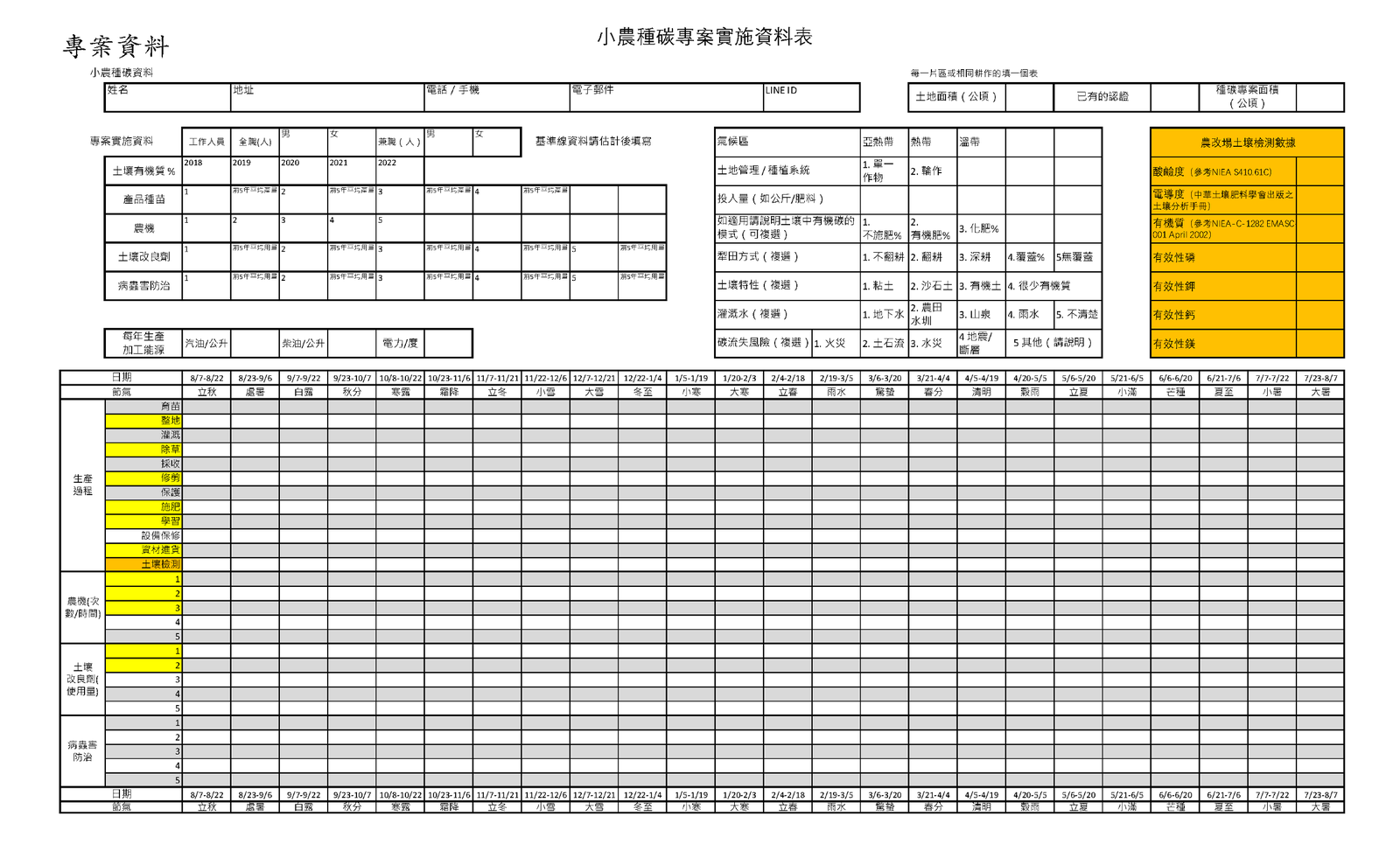
- Gradually transfer the contents of the "project data sheet" into the MiHuMiSang app
- Note: if a participating farmer can't use the MiHuMiSang app, they must fill in the work content on the "project implementation sheet" and email a photo of it to the project developer every month.
Farming method + carbon farming
1. Production process
2. Additional items: learning, maintenance, purchasing
3. Start and end dates of scheduled work
4. Select seedlings, farm machinery, soil amendments, pest and disease control, feed, packaging
5. Please make sure reminders are on (default); if reminders are off, you won't receive them
Production diary
- Scheduled work appears as coloured lines under the dates in the smallholder diary calendar, as reminders
- Take photos, check in, create diary entries, upload
- Diary entries matching the seedlings, machinery and inputs in the work schedule count towards points for carbon farming or other farming methods
- Add the length of time worked
- Add learning, maintenance and purchasing entries to meet the learning-and-growth requirements of carbon farming or other farming methods
Filling in the diary later
1. If it's inconvenient to write diary content in the field, you can save it on your phone first and fill it in later
2. Photos can be added to diary entries within one month
3. Please note! Photos record location and time and cannot be altered. They must be taken in the field while working, not at another time or place
4. Diary content can be added within one month of taking the photo; after one month it can no longer be added
Work reminders
- If "reminder" is turned on in the work schedule, the app will remind the smallholder what to do before, during and after the scheduled time
Changing the work schedule
- 1. Scheduled work can be copied, deleted or modified
- 2. Delete with care — deleted data cannot be recovered
Smallholder diary
- Photo – capture the key moments of the work; the app and system automatically record time and location
- Check in – tick the work content (including learning, maintenance, purchasing), machinery and inputs used, length of work, mood and notes.
- Upload – save and upload directly, or save on the phone first and upload after adding notes. (After uploading you can also withdraw the upload, correct it and upload again. If deleted, the data is permanently deleted and cannot be recovered.)
Note: the smallholder diary is designed so that the time and location of a photo cannot be altered. Always photograph the actual work at the real place and time, matching the work content; text and photos must not contradict each other.
Pros and cons of using the MiHuMiSang app
- Pros
- Records work content in real time, truthfully and transparently
- Convenient — all you need is a phone
- Adds planning functions that change work habits
- Tamper-proof, strengthening authenticity
- Easy to use — a record takes just one minute
- Fully digital, enabling collaboration
- Data isn't lost after uploading
- Not just for carbon farming — also usable for other farming method certifications and product records
- Lets you market products directly, completely free
- Cons
- Takes a little time to learn
- Self-monitoring — sometimes you may forget
- Requires a smartphone; some smallholders can't use apps
- Takes some time to form the habit
- Can't change things after the time has passed (but you can note that they were done later)

Dual certification: carbon reduction and sustainable development goals
- Not just carbon reduction — SDG 13 Climate Action
- Certification for the following Sustainable Development Goals (SDGs) as well:
- SDG 4 Quality Education
- SDG 8 Decent Work and Economic Growth
- SDG 2 Improving soil quality, raising yields, reducing hunger

Gold Standard claims guidelines
- The Gold Standard sets claims guidelines in line with international emission-reduction certification norms
- Publicity at different stages can begin once the project passes preliminary certification
- Not only participating smallholders but also supporting or sponsoring individuals and companies can take part in publicity
- Products targeted for carbon reduction can also disclose quantified certification of carbon reduction and sustainability indicators in publicity



Related articles -->
▶ Towards 1,000 hectares of smallholder carbon farming & FAQ (Part 2)
▶ Finally through... towards 1,000 hectares of smallholder carbon farming & FAQ (Part 1)
▶ The carbon farming project has grown! Taiwan's smallholders achieve over 10,000 tonnes of carbon farming in one year
▶ Refining diamond-grade carbon credits together
▶ Farmers' livelihoods in a just climate transition
▶ A few things about the Gold Standard carbon credit certification audit process
▶ Bringing the sustainable value of smallholder carbon farming to every consumer's table
▶ The SDG and ESG meaning of the Changliang Radish Festival
▶ The "first metre" of carbon reduction and net zero: Changliang, Hualien, a promised land for agricultural carbon reduction
▶ Investing in smallholder carbon farming: a just transition for agriculture
▶ A century-long plan typhoons can't blow away: Changliang's first metre of international carbon reduction certification
▶ Taiwan's agricultural carbon reduction methodology strides ahead
▶ Getting rich from carbon reduction? 9 myths about carbon credits
▶ Life is the foundation of carbon storage: land must be alive to be organic
▶ A key role in carbon trading: the project developer
▶ A remote Taiwanese village becomes an international carbon reduction hub: Changliang's smallholder carbon farming takes its first metre
▶ One month to the carbon exchange's opening: is Taiwan ready?


